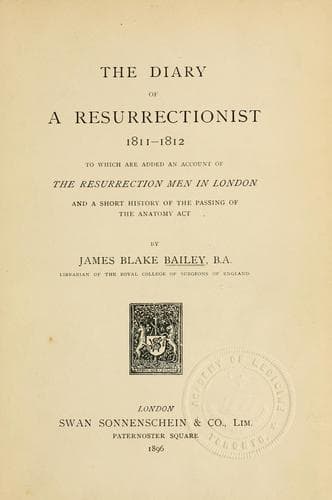
The Diary of a Resurrectionist, 1811-1812: To Which Are Added an Account of the Resurrection Men in London and a Short History of the Passing of the Anatomy Act — John Shaqi
The Diary of a Resurrectionist, 1811-1812: To Which Are Added an Account of the Resurrection Men in London and a Short History of the Passing of the Anatomy ActBailey, James Blake
History
The Diary of a Resurrectionist, 1811-1812: To Which Are Added an Account of the Resurrection Men in London and a Short History of the Passing of the Anatomy Act
Bailey, James Blake
Body snatching
"T. Light, W. Arnot, and ---- Spelling, were brought up on Wednesday. It
appeared that the prisoners were going up Holborn about half-past four
o'clock on Tuesday afternoon, with a horse and cart; they were observed by
two officers, who, knowing the prisoners to be resurrection-men, stopped
the horse and cart, and, after a hard contest, succeeded in securing the
prisoners. They then examined the contents of the cart, and found it
contained seven dead bodies of men and women; one of the bodies was
headless, but how it came to be so remains as yet to be cleared up. They
were packed up in bags and baskets. The prisoners were followed by an
immense crowd to Hatton Garden Office, whence they were committed to
prison, and the bodies deposited in the lock-up house. The cart was hired
at Battle Bridge. Some of the officers were sent to make enquiry at the
different burying-grounds. The Office was crowded with men and women, who
had some of their relatives buried on Sunday last, to see if they could
recognize any of the bodies. They were brought up again on Thursday, and
discharged."
In 1822 the case of Rex _v._ Cundick was tried at Kingston Assizes,
_coram_ Graham.[20] This was an indictment for misdemeanour. A man named
Edward Lee was executed in the parish of St. Mary, Newington; George
Cundick was employed by the keeper of the gaol to bury the body of Lee,
and for this he was paid. Instead of burying the corpse, he sold it for
dissection, or, in the words of the indictment, he "for the sake of wicked
lucre and gain did take and carry away the said body, and did sell and
dispose of the same for the purpose of being dissected, cut in pieces,
mangled, and destroyed, to the great scandal and disgrace of religion,
decency, and morality, in contempt of our Lord the King, and his laws, to
the evil example of all other persons in like cases offending." The
evidence showed plainly that Cundick had had possession of the body, and
that he had received the burial fees. On the friends of Lee wishing to see
the corpse, Cundick declared that it was already buried; but several days
after this he clandestinely went through the ceremony of burying a coffin
filled with rubbish. It was also proved that Cundick had been seen to
remove a heavy package from his house at night, and that the body of Lee
had been identified in a dissecting-room. The defence was, in the first
place, that the indictment was bad "as a perfect anomaly in the history of
criminal pleading." In the second place, if the indictment were good, it
was unsupported by evidence. It was argued by counsel that the only
evidence before the Court was that the body was not buried, and that it
was found at a dissecting-room. Without the production of the owner of the
dissecting-room, and the proof that he had bought the body from Cundick,
the jury could not be asked to give a verdict against the defendant. The
Judge, however, over-ruled these objections, and the jury found the
prisoner guilty.
Public-domain text, read in full here on John Shaqi.
Reviews
Reviews
No reviews yet
Be the first to share your thoughts on this work.
Join the Discussion
Join the discussion
Sign in to leave a comment or review.
Sign InorCreate an account