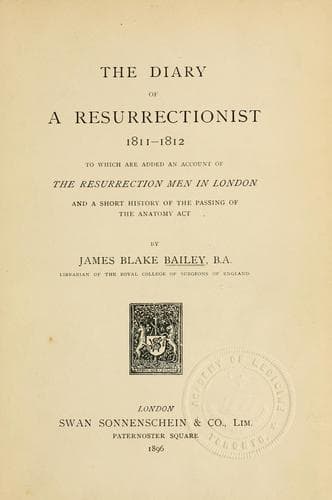
The Diary of a Resurrectionist, 1811-1812: To Which Are Added an Account of the Resurrection Men in London and a Short History of the Passing of the Anatomy ActBailey, James Blake
History
The Diary of a Resurrectionist, 1811-1812: To Which Are Added an Account of the Resurrection Men in London and a Short History of the Passing of the Anatomy Act
Bailey, James Blake
Body snatching
These trials and verdicts made it still more difficult than before to get
subjects for dissection, as even men of the Resurrectionist class
hesitated to run the risk of getting the punishment, which now the
superior Courts had upheld. Those who did run this risk very naturally
expected a price proportionate to the danger, and so the cost of subjects
was still more increased.
But to surgeons, and to teachers of anatomy, by far the most important
trial of all was that of John Davies and others, of Warrington, for
obtaining the body of Jane Fairclough, which had been taken from the
chapel-yard belonging to the Baptists, at High Cliff, Appleton, Cheshire,
in October, 1827. This case was tried at Lancaster Assizes, March 14th,
1828. The defendants were John Davies (a medical student at the Warrington
Dispensary), Edward Hall (a surgeon and apothecary in practice at
Warrington), William Blundell (an apprentice to a stationer in the same
town), and Richard Box. Thomas Ashton was also included in the indictment,
but no evidence was offered against him. There were fourteen counts in the
indictment, ten charging the defendants with conspiracy, and four charging
them with unlawfully procuring and receiving the body of Jane Fairclough.
It appears, from the report of the trial, that Davies called on Dr. Moss,
one of the Physicians to the Dispensary, and obtained permission to use a
building in his garden for the purpose of dissecting a subject which he
had purchased. Mr. Hall, on behalf of Davies, paid four guineas to the men
who brought the body to a cellar in Warrington, but he knew nothing more
of the transaction; from the cellar the body was removed to Dr. Moss'
premises by Blundell and another man, and was received by Davies and a
servant of Dr. Moss. Information of the exhumation seems to have quickly
got about. The funeral was on a Friday; on the Monday following the grave
was undisturbed, but on Tuesday the soil was spread about, and an
examination of the grave showed that the corpse had been removed. The
body was identified at Dr. Moss' house, and was taken away before any
dissection had been performed on it.
Public-domain text, read in full here on John Shaqi.
Reviews
Reviews
No reviews yet
Be the first to share your thoughts on this work.
Join the Discussion
Join the discussion
Sign in to leave a comment or review.
Sign InorCreate an account