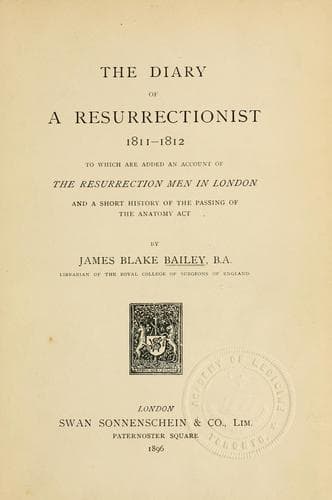
The Diary of a Resurrectionist, 1811-1812: To Which Are Added an Account of the Resurrection Men in London and a Short History of the Passing of the Anatomy ActBailey, James Blake
History
The Diary of a Resurrectionist, 1811-1812: To Which Are Added an Account of the Resurrection Men in London and a Short History of the Passing of the Anatomy Act
Bailey, James Blake
Body snatching
It was very strongly urged that the Act of Geo. II., which ordered the
bodies of all murderers executed in London and Middlesex to be anatomized
by the Surgeons' Company, ought to be repealed. No doubt this provision
much increased the dislike of the poor to any regulations by which the
bodies of their friends might be given up for dissection after death. It
was felt that dissection by the Surgeons was part of the sentence passed
on a murderer, and therefore carried with it shame and disgrace. To make
provision by law, therefore, for the dissection of the bodies of any other
class of persons was, not unnaturally, distasteful, in that it partly put
them in the same position as murderers.
The answer to the desire for the repeal of this obnoxious clause was that
nothing must be done to weaken the law; it was stated that to withdraw the
part of the sentence which related to dissection would rob the punishment
of its prohibitive effect. It is somewhat difficult to understand the
argument; surely if the risk of suffering the extreme penalty of the law
would not keep a man from crime, the extra chance of being dissected after
death could hardly be expected to do so. As Sir Henry Halford said, "I
certainly think that while that law remains they [the public] will connect
the crime of murder with the practice of dissection; an order to be
dissected, and a permission to be dissected, seem to be too slight a
distinction."
Another objection to the dissection of murderers came from the teachers.
They stated that when the body of a notorious criminal was lying at either
of the Anatomical Schools, the proprietor was pestered by persons of a
morbid turn of mind for permission to view the body. This difficulty was
also felt by the College of Surgeons, and in consequence a placard was
hung up outside the place where the dissections were made, giving notice
that no person could be admitted, unless accompanied by a member of the
Court of Assistants.
Public-domain text, read in full here on John Shaqi.
Reviews
Reviews
No reviews yet
Be the first to share your thoughts on this work.
Join the Discussion
Join the discussion
Sign in to leave a comment or review.
Sign InorCreate an account