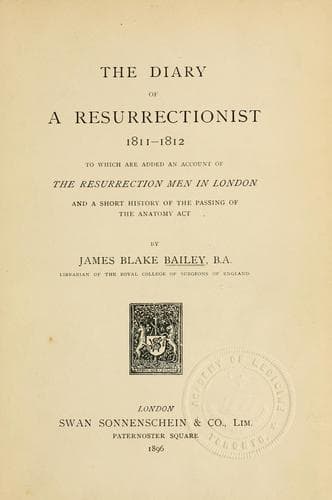
The Diary of a Resurrectionist, 1811-1812: To Which Are Added an Account of the Resurrection Men in London and a Short History of the Passing of the Anatomy ActBailey, James Blake
History
The Diary of a Resurrectionist, 1811-1812: To Which Are Added an Account of the Resurrection Men in London and a Short History of the Passing of the Anatomy Act
Bailey, James Blake
Body snatching
To make dissection less distasteful to the general public, and to show the
advantages of anatomy, some endeavours were made to explain the structure
of the human body to non-professional persons. In Ireland Sir Philip
Crampton lectured with open doors, and gave demonstrations in anatomy to
poor people. These persons, he tells us, became interested in the subject,
and often brought him bodies for dissection. A newspaper cutting of 1829
shows that this was also tried in London. A surgeon called in the
overseers and churchwardens of St. Clement Danes, and gave a demonstration
on a body, explaining its construction, and the use of the internal
organs. "By this means," says the paragraph, "he so fully absorbed the
self-interest of his audience as to extinguish the pre-conceived notions
of horror and disgust attached to the idea of a spectacle of this
description. The enlightened governors of the parish assented to the _post
mortem_ examination of the body of every unclaimed pauper, an enquiry into
whose case might appear conducive to the interests of medical science."
It has been already pointed out that, to try to overcome the repugnance to
dissection, some persons left specific instructions that their bodies
should be used for this purpose.
The representations of the teachers were so far successful, that in 1828 a
Select Committee was appointed by the House of Commons "to enquire into
the manner of obtaining subjects for dissection in the Schools of Anatomy,
and into the state of the law affecting the persons employed in obtaining
and dissecting bodies." Amongst those who gave evidence before the
Committee were the principal teachers of anatomy, and three of the
resurrection-men. The tone of the Report was decidedly in sympathy with
the teachers, but it strongly condemned the way in which they were
compelled to obtain bodies for dissection. After showing how badly off
English students were for opportunities of learning anatomy, as compared
with those of foreign countries, and pointing out that those students who
really wished to master their art were compelled to go abroad, the Report
proceeds: "These disadvantages affecting the teachers are such, that
except in the most frequented schools, attached to the greater hospitals,
few have been able to continue teaching with profit, and some private
teachers have been compelled to give up their schools. To the evils
enumerated it may be added, that it is distressing to men of good
education and character to be compelled to resort, for their means of
teaching, to a constant infraction of the laws of their country, and to be
made dependent, for their professional existence, on the mercenary
caprices of the most abandoned class in the community."
Public-domain text, read in full here on John Shaqi.
Reviews
Reviews
No reviews yet
Be the first to share your thoughts on this work.
Join the Discussion
Join the discussion
Sign in to leave a comment or review.
Sign InorCreate an account