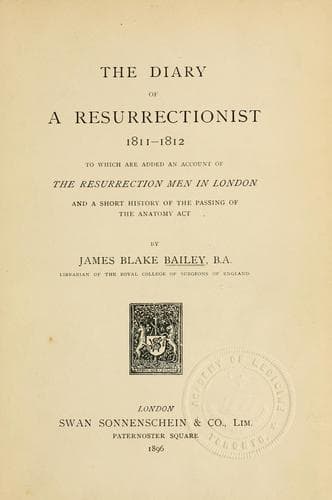
The Diary of a Resurrectionist, 1811-1812: To Which Are Added an Account of the Resurrection Men in London and a Short History of the Passing of the Anatomy ActBailey, James Blake
History
The Diary of a Resurrectionist, 1811-1812: To Which Are Added an Account of the Resurrection Men in London and a Short History of the Passing of the Anatomy Act
Bailey, James Blake
Body snatching
There was strong opposition to the Bill outside the House. Some of the
private teachers were very uneasy as regarded the effect of the Bill on
themselves. The measure spoke of "recognized teachers" and "hospital
schools," and all those who were to be entitled to the benefits of the Act
were to have licences from one of the Medical Corporations. The
proprietors of the smaller schools felt that this would result in their
extinction, and that the teaching would all pass to the large schools. In
the country, too, there was strong opposition to the Bill, as
practitioners there felt that they were excluded from any benefit. The
_Lancet_, always ready in those days with a nickname, dubbed the measure
"A Bill for Preventing Country Surgeons from Studying Anatomy." The
College of Surgeons also petitioned against the Bill. The Council felt
that the appointment of Commissioners, who were to have complete control
over all schools and places of dissection, would greatly interfere with
the privileges of the College. It was pointed out to the House of Commons
that the establishment of a Board, such as that proposed by the Bill, was
virtually placing the whole profession of surgery under the control of
Commissioners, not one of whom need be a member of the profession, and the
majority of whom must not be so.
Another fault of the Bill was that it did not apply to Ireland. A large
supply of bodies was regularly sent from that country to England and
Scotland, and it was felt that to exclude Ireland from the provisions of
the Bill, was simply increasing the temptation for bodies to be still more
largely exported therefrom.
It was also argued that the Bill would tell hardly against the poor, as
they would refuse to go into workhouses or hospitals if they thought that
their bodies would be dissected after death. For this objection there was
no foundation, and Mr. Peel pointed out, in the debate on the third
reading, that "it was the poor who would really be benefited by the
measure. The rich could always command good advice, whilst the poor had a
strong interest in the general extension of anatomical science."
The Bill passed the Commons, but was lost in the Lords.
In 1830, Lord Calthorpe was to have again introduced the Bill into the
Upper House, but the intention was abandoned on account of the threatened
dissolution of Parliament. As the _Lancet_ expressed it, "Dissolution has
so many horrors, that a discussion on the _subject_ at the present time
would be by no means agreeable."
Public feeling was now very strong in favour of some law to prevent the
wholesale spoliation of graves, which was going on practically unchecked.
But, as has happened frequently in legislation, the absolute necessity for
a change in the law was brought within the range of practical politics by
a crime of a most diabolical character, one which, in this country,
created a sensation equal to that raised in Scotland by the atrocities of
Burke and Hare in Edinburgh.
Public-domain text, read in full here on John Shaqi.
Reviews
Reviews
No reviews yet
Be the first to share your thoughts on this work.
Elsewhere in the archive
Join the Discussion
Join the discussion
Sign in to leave a comment or review.
Sign InorCreate an account