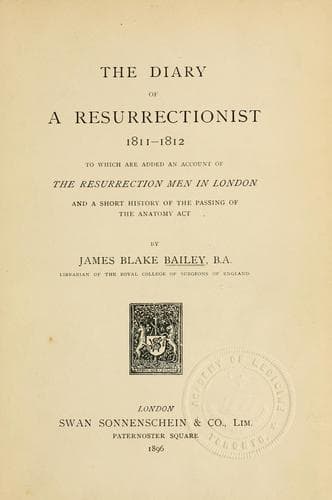
The Diary of a Resurrectionist, 1811-1812: To Which Are Added an Account of the Resurrection Men in London and a Short History of the Passing of the Anatomy ActBailey, James Blake
History
The Diary of a Resurrectionist, 1811-1812: To Which Are Added an Account of the Resurrection Men in London and a Short History of the Passing of the Anatomy Act
Bailey, James Blake
Body snatching
In March, 1829, Mr. Warburton obtained leave to introduce into the House
of Commons "A Bill for preventing the unlawful disinterment of human
bodies, and for regulating Schools of Anatomy." In this Bill it was
enacted that persons found guilty of disinterring any human body from any
churchyard, burial-ground or vault, or assisting at any such disinterment,
should be imprisoned for a term not exceeding six months for the first
offence, and two years for the second offence. Seven Commissioners were to
be appointed; the majority of these were not to be either physicians,
surgeons, or apothecaries. All unclaimed bodies of persons dying in
workhouses or hospitals, were, seventy-two hours after death, to be given
over for purposes of dissection; but if within this specified time a
relative appeared and requested that the body might not be used for
anatomical purposes, such request was to be granted. Another proposed
change in the law was that a person might legally bequeath his body for
dissection; in such cases the executors, administrators, or next-of-kin
had the option of carrying out the wishes of the testator, or declining to
do so, as they thought fit. A heavy penalty was laid on persons who were
found carrying on human anatomy in an unlicensed building, and it was made
an offence to move a body from one place to another, without a licence for
so doing. All bodies used for dissection were to be buried; the penalty
for failing to do this was fifty pounds.
One great blot on this Bill was the neglecting to repeal the clause which
ordered the bodies of murderers to be given up for dissection. As pointed
out on page 87, this was one of the great reasons which made dissection so
hateful to the poor. During the debate, a motion was made by Sir R. Inglis
"to repeal so much of the Act 9 Geo. IV. cap. 31, as empowers judges to
order the bodies of murderers to be given over for dissection." This,
however, was lost, eight members only voting for the amendment, and forty
against.
Public-domain text, read in full here on John Shaqi.
Reviews
Reviews
No reviews yet
Be the first to share your thoughts on this work.
Join the Discussion
Join the discussion
Sign in to leave a comment or review.
Sign InorCreate an account