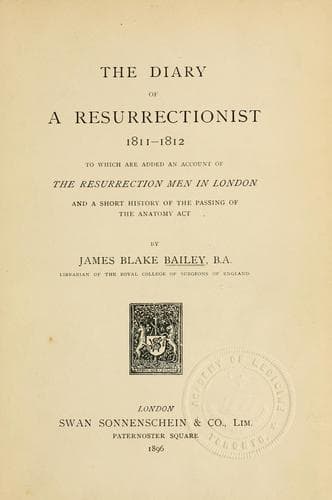
The Diary of a Resurrectionist, 1811-1812: To Which Are Added an Account of the Resurrection Men in London and a Short History of the Passing of the Anatomy ActBailey, James Blake
History
The Diary of a Resurrectionist, 1811-1812: To Which Are Added an Account of the Resurrection Men in London and a Short History of the Passing of the Anatomy Act
Bailey, James Blake
Body snatching
May had been brought up as a butcher, but this trade he gave up, and
became possessed of a horse and cart with which he was supposed to ply
for hire. The real business of the vehicle, however, seems to have been to
convey bodies from place to place for the Resurrectionists. Shields, the
porter to the gang, had been watchman and grave-digger at the Roman
Catholic Chapel in Moorfields, so that he was most useful to the other
Resurrectionists in giving information, and in granting facilities for the
removal of bodies. No evidence was offered against him in connection with
the murder of the Italian boy. Soon after the trial he attempted to get
work as a porter in Covent Garden Market, but on his being recognized by
those working there, a shout of "Burker!" was raised, and Shields narrowly
escaped with his life, and took refuge in the Police Office.
[Illustration: JOHN HEAD, _alias_ THOMAS WILLIAMS. JOHN BISHOP. Executed
December 5, 1831. From Drawings by W. H. CLIFT, made directly after the
execution.]
This one incident as regards Shields gives an idea of the public feeling
towards the resurrection-men, and that feeling was quite as bitter towards
the anatomists. It was therefore absolutely necessary that some determined
steps should be taken as regards legislation.
In December, 1831, Mr. Warburton again introduced a Bill into the House of
Commons; it passed safely through both Houses, and became law on August
1st, 1832. By this new Act the Secretary of State for the Home Department
in Great Britain, and the Chief Secretary in Ireland, were empowered to
grant licences for anatomical purposes to any person lawfully qualified to
practise medicine, to any professor or teacher of anatomy, and to students
attending any school of medicine, on an application signed by two justices
of the peace, who could certify that the applicant intended to carry on
the practice of anatomy. It was enacted that executors, or other persons
having lawful possession of a body (provided they were not undertakers, or
persons to whom the body had been handed over for purposes of interment),
might give it up for dissection unless the deceased had expressed a wish
during his life that his body should not be so used, or unless a known
relative objected to the body being given up. If a person had expressed a
wish to be dissected, this wish was to be carried out unless the relatives
raised any objection. No body might be moved for anatomical purposes until
forty-eight hours after death, nor until the expiration of a twenty-four
hours' notice to the Inspector of Anatomy; a proper death certificate had
also to be signed by the medical attendant before the body could be moved.
Provision was made for the decent removal of all bodies, and for their
burial in consecrated ground, or in some public burial-ground in use for
persons of that religious persuasion to which the person, whose body was
so removed, belonged. A certificate of the interment was to be sent to the
Public-domain text, read in full here on John Shaqi.
Reviews
Reviews
No reviews yet
Be the first to share your thoughts on this work.
Elsewhere in the archive
Join the Discussion
Join the discussion
Sign in to leave a comment or review.
Sign InorCreate an account