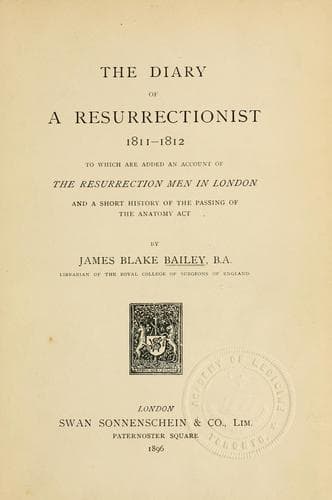
The Diary of a Resurrectionist, 1811-1812: To Which Are Added an Account of the Resurrection Men in London and a Short History of the Passing of the Anatomy ActBailey, James Blake
History
The Diary of a Resurrectionist, 1811-1812: To Which Are Added an Account of the Resurrection Men in London and a Short History of the Passing of the Anatomy Act
Bailey, James Blake
Body snatching
Inspector within six weeks after the day on which the body was received.
No licensed person was to be liable to any prosecution, penalty,
forfeiture, or punishment for having a body in his possession for
anatomical purposes according to the provisions of the Act.
Perhaps the most important clause was that which did away with the
dissection of the bodies of murderers. This was done by Section XVI.,
which ran as follows:
"And whereas an Act was passed in the Ninth Year of the Reign of His late
Majesty, for consolidating and amending the Statutes in England relative
to Offences against the Person, by which latter Act it is enacted, that
the Body of every Person convicted of Murder shall, after Execution,
either be dissected or hung in Chains, as to the Court which tried the
Offender shall deem meet; and that the Sentence to be pronounced by the
Court shall express that the Body of the Offender shall be dissected or
hung in Chains, whichever of the Two the Court shall order. Be it enacted,
That so much of the said last-recited Act as authorizes the Court, if it
shall see fit, to direct that the Body of a Person convicted of Murder
shall after Execution, be dissected, be and the same is hereby repealed:
and that in every case of Conviction of any Prisoner for Murder, the Court
before which such Prisoner shall have been tried shall direct such
Prisoner either to be hung in Chains or buried within the Precincts of the
Prison in which such Prisoner shall have been confined after conviction,
as to such Court shall deem meet; and that the sentence to be pronounced
by the Court shall express that the body of such Prisoner shall be hung in
Chains, or buried within the Precincts of the Prison, whichever of the two
the Court shall order."
Three Inspectors were appointed to carry out the provisions of the Act.
The first Inspectors were Dr. J. C. Somerville, for England; Dr. Craigie,
of Edinburgh, for Scotland; and Sir James Murray, of Dublin, for Ireland.
There was no provision for punishing persons found violating graves; it
had been already decided that this was an offence at common law; and
presumably the framers of the Act had, at last, sufficient faith in their
measure to believe that it would put an end to the proceedings of the
resurrection-men. If that were so, they were not disappointed. After the
passing of the Act the resurrection-man, as such, drops out of history;
his occupation was gone, and one of the most nefarious trades that the
world has ever seen came completely to an end. Public feeling against
these men did not all at once subside; this strongly militated against
their getting employment, and some of them moved to other quarters, where
they lived under assumed names.
Public-domain text, read in full here on John Shaqi.
Reviews
Reviews
No reviews yet
Be the first to share your thoughts on this work.
Elsewhere in the archive
Join the Discussion
Join the discussion
Sign in to leave a comment or review.
Sign InorCreate an account