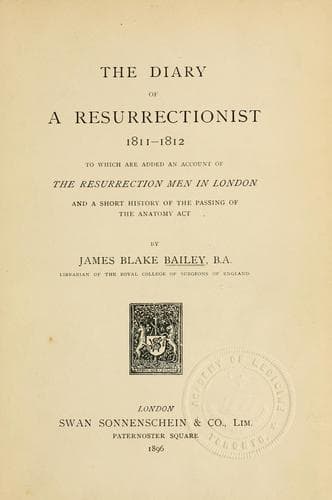
The Diary of a Resurrectionist, 1811-1812: To Which Are Added an Account of the Resurrection Men in London and a Short History of the Passing of the Anatomy ActBailey, James Blake
History
The Diary of a Resurrectionist, 1811-1812: To Which Are Added an Account of the Resurrection Men in London and a Short History of the Passing of the Anatomy Act
Bailey, James Blake
Body snatching
In Germany the bodies of persons who died in prisons, or penitentiaries,
and those of suicides, were given up for dissection, unless the friends of
the deceased cared to pay a certain sum to the funds of the school; in
this case the body was handed over to the friends. Other sources of supply
were the bodies of those persons who died without leaving sufficient to
pay the cost of burial, poor people who had been supported at the public
cost, all persons executed, and public women. Although these regulations
were not rigorously carried out, there was an ample supply of bodies for
anatomical purposes, and the resurrection-men were unknown.
* * * * *
In Austria, if the medical attendant thought necessary, a _post mortem_
was made on all patients who died in hospital, but only unclaimed bodies
were used for dissection; these were given up to the teachers forty-eight
hours after death. In Vienna the supply came from the General Hospital;
this was sufficient for all purposes, and there was no recourse to
exhumation.
* * * * *
The supply in Italy came from a source similar to that of the other
countries named. The rule was that all bodies of persons who died in
hospital were given up for dissection if required; but, by paying the cost
of the funeral, friends could, if they wished, take away the body. This,
however, was seldom done. There was generally a sufficient supply of
bodies; but, if this ran short, the subjects were obtained from "the
deposit" of poor people who died and were buried at the public cost. In
every parish church in Italy there was a chamber in which all the dead
bodies of the poor were deposited during the day-time, after the religious
ceremonies had been performed over them in the church; at night these
bodies were removed either to the dissecting-room or to the burial-fields,
outside the town. Body-snatching was quite unknown.
* * * * *
There was an ample supply of bodies in Portugal from similar sources.
Mortality was very high amongst infants, who were put into _roda_, or
foundling cradles; the bodies of these children could be obtained without
any difficulty. In Portugal the resurrection-man did not exist.
* * * * *
In Holland there was no lack of material for teaching anatomy, and for
students to learn operative surgery on the dead body. The Dissecting
School at Leyden was supplied from the civil hospitals at Amsterdam. There
was no prejudice against dissection in Holland; in all the principal towns
lectures on anatomy were publicly given, and dissected subjects were
exhibited. Here, again, exhumation was not necessary, and was unknown.
* * * * *
Public-domain text, read in full here on John Shaqi.
Reviews
Reviews
No reviews yet
Be the first to share your thoughts on this work.
Elsewhere in the archive
Join the Discussion
Join the discussion
Sign in to leave a comment or review.
Sign InorCreate an account