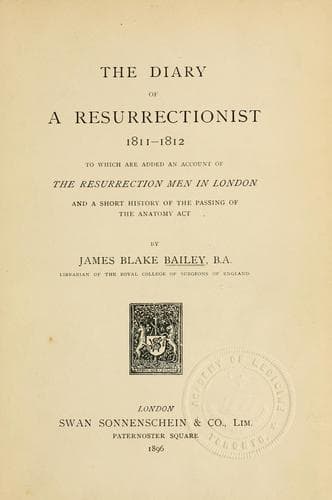
The Diary of a Resurrectionist, 1811-1812: To Which Are Added an Account of the Resurrection Men in London and a Short History of the Passing of the Anatomy ActBailey, James Blake
History
The Diary of a Resurrectionist, 1811-1812: To Which Are Added an Account of the Resurrection Men in London and a Short History of the Passing of the Anatomy Act
Bailey, James Blake
Body snatching
In looking back it is impossible not to regret that Parliament was so slow
to believe that legislation in the direction of the Anatomy Act would do
away with the evils of the resurrection-men. This fact was urged upon them
by the teachers; but popular feeling was so dead against the anatomists,
who were thought to be responsible for even the worst crimes of the
resurrection-men, that Parliament seemed to fear to do anything which
favoured the teachers, although the great disadvantages under which they
suffered were thoroughly well known. Perhaps the best tribute to the
success of the Act, is the very small alterations which have been made in
it between 1832 and the present day.
A glance at the regulations in force in foreign countries for the supply
of bodies, at the time of the passing of the Anatomy Act, shows that when
a fair provision was made by law for the supply of bodies, the
resurrection-men were unknown. The great advantages of the student on the
Continent, as compared with his brethren in England, were thus pointed out
to the Committee by Mr. [afterwards Sir] William Lawrence: "I see many
medical persons from France, Germany, and Italy, and have found, from my
intercourse with them, that anatomy is much more successfully cultivated
in those countries than in England; at the same time I know, from their
numerous valuable publications on anatomy, that they are far before us in
this science; we have no original standard works at all worthy of the
present state of knowledge." It was also shown that this fact was chiefly
the result of the greater opportunities for getting subjects abroad, and
that teachers found that those English students who had been to foreign
schools were the best informed.
* * * * *
Before the Revolution in France the hospitals of Paris were supported by
voluntary contributions, and each had separate funds and Boards of
Management, similar to the hospitals in London at the present day. At the
Revolution these Boards were consolidated, and one administrative body was
formed. This "Administration des Hôpitaux, Hospices et Secours à Domicile
de Paris," carried into effect the law passed by the Legislative Assembly,
that the bodies of all those persons who died in hospitals, which were
unclaimed within twenty-four hours after death, should be given up for
anatomical purposes. The distribution from the hospitals to the medical
schools was systematically carried out, generally at night. By Art. 360
of the Penal Code, the punishment for violation of a place of sepulture
was imprisonment for a term varying from three months to a year, and a
fine of from 60 to 200 francs. The result of these regulations was that
exhumation for anatomical purposes was quite unknown.
* * * * *
Public-domain text, read in full here on John Shaqi.
Reviews
Reviews
No reviews yet
Be the first to share your thoughts on this work.
Elsewhere in the archive
Join the Discussion
Join the discussion
Sign in to leave a comment or review.
Sign InorCreate an account