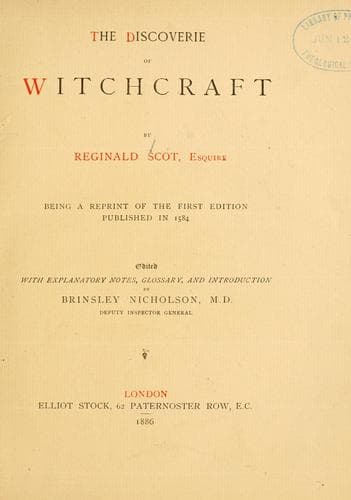
Demonology -- Early works to 1800; Magic -- Early works to 1800; Witchcraft -- Early works to 1800
Item, an equivocall or doubtfull answer is taken for a confession
against a witch.
♦_L. non alienum eodem._♦
Item, _Bodin_ reporteth, that one confessed that he went out, or rather
up into the aire, and was transported manie miles to the fairies
danse, onelie bicause he would spie unto what place his wife went
to hagging, and how she behaved hir selfe. Whereupon was much a doo
among the inquisitors and lawyers, to discusse whether he should be
executed with his wife or no. But it was concluded that he must die,
bicause he bewraied not his wife: the which he forbare to doo, _Propter
reverentiam honoris & familiæ_.
♦_L. de ætat. 5. nihil eodem. &c._♦
♦_I. Bod. de dæmono. lib. 4. cap. 3._♦
Item, if a woman confesse freelie herein, before question be made; and
yet afterward denie it: she is neverthelesse to be burned.
Item, they affirme that this extremitie is herein used, bicause not
one among a thousand witches is detected. And yet it is affirmed by
_Sprenger_, in _M. Mal._ that there is not so little a parish, but
there are manie witches knowne to be therein.
The fift Chapter.
_Presumptions, whereby witches are condemned._
If anie womans child chance to die at hir hand, so as no bodie knoweth
how; it may not be thought or presumed that the mother killed it,
except she be supposed a witch: and in that case it is otherwise, for
she must upon that presumption be executed; except she can proove the
negative or contrarie.
♦_I. Bod. de dæmono. lib. 4 cap. 4._♦
Item, if the child of a woman that is suspected to be a witch,
be lacking or gone from hir; it is to be presumed, that she hath
sacrificed it to the divell: except she can proove the negative or
contrarie.
Item, though in other persons, certeine points of their confessions may
be thought erronious, and imputed to error: yet (in witches causes) all
oversights, imperfections, and escapes must be adjudged impious and
malicious, and tend to hir confusion and condemnation.
Item, though a theefe be not said in lawe to be infamous in any other
matter than in theft; yet a witch defamed of witchcraft is said to be
defiled with all maner of faults and infamies universallie, though she
were not condemned; but (as I said) defamed with the name of a witch.
For rumors and reports are sufficient (saith _Bodin_) to condemne a
witch.
Item, if any man, woman, or child doo saie, that such a one is a witch;
it is a most vehement suspicion (saith _Bodin_) and sufficient to bring
hir to the racke: though in all other cases it be directlie against
lawe.
♦_I. Bod. de dæmono. lib. 4. cap. 4._♦
Item, in presumptions and suspicions against a witch, the common brute
or voice of the people cannot erre.
♦_L. decurionè de pœnis._
_Panorm. & Felin. in C. veniens. 1. de testib. parsi causa. 15 4._
_Lib. 4. numero. 12. usq; a 18._♦
Public-domain text, read in full here on John Shaqi.
Reviews
Reviews
No reviews yet
Be the first to share your thoughts on this work.
Elsewhere in the archive
Join the Discussion
Join the discussion
Sign in to leave a comment or review.
Sign InorCreate an account