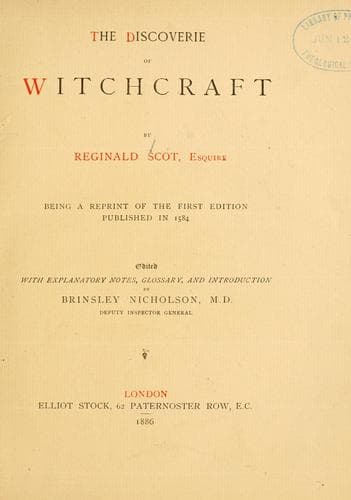
Demonology -- Early works to 1800; Magic -- Early works to 1800; Witchcraft -- Early works to 1800
I neede not staie to confute such parciall and horrible dealings, being
so apparentlie impious, and full of tyrannie which except I should have
so manifestlie detected, even with their owne writings and assertions,
few or none would have beleeved. But for brevities sake I will passe
over the same; supposing that the citing of such absurdities may stand
for a sufficient confutation thereof. Now therefore I will proceed
to a more particular order and maner of examinations, &c: used by the
inquisitors, and allowed for the most part throughout all nations.
First the witch must be demanded, why she touched such a child, or such
a cow, &c: and afterward the same child or cow fell sicke or lame, &c.
♦_Mal. malef. super, interrog._♦
Item, why hir two kine give more milke than hir neighbors. And the
note before mentioned is heere againe set downe, to be speciallie
observed of all men: to wit; that Though a witch cannot weepe, yet she
may speake with a crieng voice. Which assertion of weeping is false,
and contrarie to the saieng of _Seneca_, _Cato_, and manie others;
which affirme, that A woman weepeth when she meaneth most deceipt: and
therefore saith _M. Mal._ she must be well looked unto, otherwise she
will put spettle privilie upon hir cheeks, and seeme to weepe: which
rule also _Bodin_ saith is infallible. But alas that teares should be
thought sufficient to excuse or condemne in so great a cause, and so
weightie a triall! I am sure that the woorst sort of the children of
Israel wept bitterlie: yea, if there were any witches at all in Israel,
they wept. For it is written, that all the children of Israel wept.
Finallie, if there be any witches in hell, I am sure they weepe: for
there is weeping, wailing, and gnashing of teeth.
♦_Seneca in tragœd._♦
♦_Mal. malef. part. 3. quæst 15. act. 10._♦
♦Num. 11, 4.
1. Sam. 11, 4.
2. Sa. 15, 23.
Mat. 8. & 13. & 22. & 24. & 25.
Luke 3. &c.♦
But God knoweth, many an honest matrone cannot sometimes in the
heavines of her heart shed teares; the which oftentimes are more readie
and common with craftie queanes and strumpets, than with sober women.
For we read of two kinds of teares in a womans eie, the one of true
greefe, the other of deceipt. And it is written, that _Dediscere flere
fæminam est mendacium_: which argueth, that they lie which say, that
wicked women cannot weepe. But let these tormentors take heed, that
the teares in this case which runne downe the widowes cheeks, with
their crie spoken of by Jesus Sirach, be not heard above. But lo what
learned, godlie, and lawfull meanes these popish inquisitors have
invented for the triall of true or false teares.
♦_Seneca in tragœd._♦
♦Eccl. 35, 15.♦
The seventh Chapter.
_The inquisitors triall of weeping by conjuration._
Public-domain text, read in full here on John Shaqi.
Reviews
Reviews
No reviews yet
Be the first to share your thoughts on this work.
Elsewhere in the archive
Join the Discussion
Join the discussion
Sign in to leave a comment or review.
Sign InorCreate an account