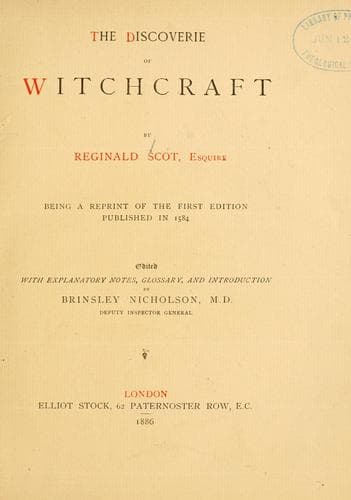
Demonology -- Early works to 1800; Magic -- Early works to 1800; Witchcraft -- Early works to 1800
After three yeares were passed over, in a morning betimes he went to
towne before his dame; who upon some occasion (of like to make water)
staied a little behind. In the meane time being neere to a church,
he heard a little saccaring bell ring to the elevation of a morrowe
masse, and not daring to go into the church, least he should have beene
beaten and driven out with cudgels, in great devotion he fell downe in
the churchyard, upon the knees of his hinder legs, and did lift his
forefeet over his head, as the preest doth hold the sacrament at the
elevation. Which prodigious sight when certeine merchants of _Genua_
espied, and with woonder beheld; anon commeth the witch with a cudgell
in hir hand, beating foorth the asse. And bicause (as it hath beene
said) such kinds of witchcrafts are verie usuall in those parts; the
merchants aforesaid made such meanes, as both the asse and the witch
were attached by the judge. And she being examined and set upon the
racke, confessed the whole matter, and promised, that if she might
have libertie to go home, she would restore him to his old shape:
and being dismissed, she did accordinglie. So as notwithstanding they
apprehended hir againe, and burned hir: and the yoong man returned into
his countrie with a joifull and merrie hart.
♦Note the devotion of the asse.♦
Upon the advantage of this storie _M. Mal. Bodin_, and the residue
of the witchmongers triumph; and speciallie bicause S. _Augustine_
subscribeth thereunto; or at the least to the verie like. Which I
must confesse I find too common in his books, insomuch as I judge
them rather to be foisted in by some fond papist or witchmonger,
than so learned a mans dooings. The best is, that he himselfe is no
eiewitnesse to any of those his tales; but speaketh onelie by report;
wherein he uttereth these words: to wit, that It were a point of great
incivilitie, &c: to discredit so manie and so certeine reports. And in
that respect he justifieth the corporall transfigurations of _Ulysses_
his mates, throgh the witchcraft of _Circes_: and that foolish fable
of _Præstantius_ his father, who (he saith) did eate provender and
haie among other horsses, being himselfe turned into an horsse. Yea
he verifieth the starkest lie that ever was invented, of the two
alewives that used to transforme all their ghests into horsses, and
to sell them awaie at markets and faires. And therefore I saie with
_Cardanus_, that how much _Augustin_ saith he hath seen with his eies,
so much I am content to beleeve. Howbeit S. _Augustin_ concludeth
against _Bodin_. For he affirmeth these transubstantiations to be but
fantasticall, and that they are not according to the veritie, but
according to the appearance. And yet I cannot allow of such appearances
made by witches, or yet by divels: for I find no such power given by
God to any creature. And I would wit of S. _Augustine_, where they
became, whom _Bodins_ transformed woolves devoured. But
♦_August lib. 18. de civi. Dei. cap. 17 & 18._♦
Public-domain text, read in full here on John Shaqi.
Reviews
Reviews
No reviews yet
Be the first to share your thoughts on this work.
Elsewhere in the archive
Join the Discussion
Join the discussion
Sign in to leave a comment or review.
Sign InorCreate an account