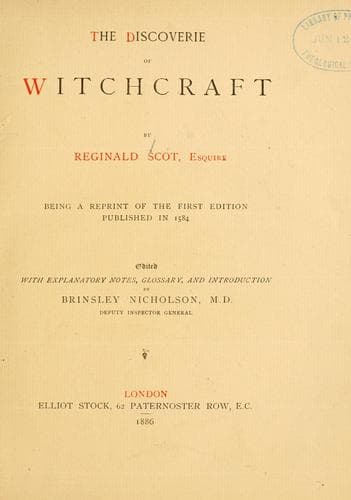
Demonology -- Early works to 1800; Magic -- Early works to 1800; Witchcraft -- Early works to 1800
_Chasaph_, being an Hebrue word, is Latined _Veneficium_, and is
in English, poisoning, or witchcraft; if you will so have it. The
Hebrue sentence written in _Exodus_, 22. is by the 70. interpretors
translated thus into Greeke, Φαρμακοῦς οὐκ ἐπιζεώσετε, which in Latine
is, _Veneficos (sive) veneficas non retinebitis in vita_, in English,
You shall not suffer anie poisoners, or (as it is translated) witches
to live. The which sentence _Josephus_ an Hebrue borne, and a man of
great estimation, learning and fame, interpreteth in this wise; Let
none of the children of Israel have any poison that is deadlie, or
prepared to anie hurtfull use. If anie be apprehended with such stuffe,
let him be put to death, and suffer that which he ment to doo to them,
for whom he prepared it. The _Rabbins_ exposition agree heerewithall.
_Lex Cornelia_ differeth not from this sense, to wit, that he must
suffer death, which either maketh, selleth, or hath anie poison, to the
intent to kill anie man. This word is found in these places following:
_Exodus._ 22, 18. _Deut._ 18, 10. 2. _Sam._ 9, 22. _Dan._ 2, 2. _2.
Chr._ 33, 6. _Esay._ 47, 9, 12. _Malach_, 3, 5. _Jerem._ 27, 9. _Mich._
5, 2. _Nah._ 3, 4. _bis_. Howbeit, in all our English translations,
_Chasaph_ is translated, witchcraft.
♦_Joseph. in Judæorum antiquitat._♦
And bicause I will avoid prolixitie and contention both at once, I
will admit that _Veneficæ_ were such witches, as with their poisons
did much hurt among the children of Israell; and I will not denie that
there remaine such untill this daie, bewitching men, and making them
beleeve, that by vertue of words, and certeine ceremonies, they bring
to passe such mischeefes, and intoxications, as they indeed accomplish
by poisons. And this abuse in cousenage of people, together with the
taking of Gods name in vaine, in manie places of the scripture is
reprooved, especiallie by the name of witchcraft, even where no poisons
are. According to the sense which S. _Paule_ useth to the _Galathians_
in these words, where he sheweth plainelie, that the true signification
of witchcraft is cousenage; O ye foolish _Galathians_ (saith he) who
hath bewitched you? to wit, cousened or abused you, making you beleeve
a thing which is neither so nor so. Whereby he meaneth not to aske of
them, who have with charmes, &c: or with poisons deprived them of their
health, life, cattell, or children, &c: but who hath abused or cousened
them, to make them beleeve lies. This phrase is also used by _Job._
15. But that we may be throughlie resolved of the true meaning of this
phrase used by _Paule_, _Gal._ 3. let us examine the description of a
notable witch called _Simon Magus_, made by S. _Luke_; There was (saith
he) in the citie of _Samaria_, a certeine man called _Simon_, which
used witchcraft, and bewitched the people of _Samaria_, saieng that
he himself was some great man. I demand, in what other thing here do
we see anie witchcraft, than that he abused the people, making them
Public-domain text, read in full here on John Shaqi.
Reviews
Reviews
No reviews yet
Be the first to share your thoughts on this work.
Elsewhere in the archive
Join the Discussion
Join the discussion
Sign in to leave a comment or review.
Sign InorCreate an account