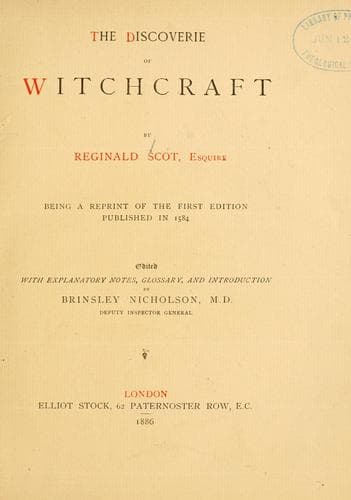
Demonology -- Early works to 1800; Magic -- Early works to 1800; Witchcraft -- Early works to 1800
It is objected, that if _Veneficium_ were comprehended under the
title of manslaughter, it had beene a vaine repetition, and a
disordered course undertaken by _Moses_, to set foorth a lawe against
_Veneficas_ severallie. But it might suffice to answer any reasonable
christian, that such was the pleasure of the Holie-ghost, to institute
a particular article herof, as of a thing more odious, wicked and
dangerous, than any other kind of murther. But he that shall read the
lawe of _Moses_, or the testament of Christ himselfe, shall find this
kind of repetition and reiteration of the law most common. For as it is
written _Exod._ 22, 21. Thou shalt not greeve nor afflict a stranger,
for thou wast a stranger in the land of _Aegypt_: so are the same words
found repeated in _Levit._ 19, 33. Polling and shaving of heads and
beards is forbidden in _Deut._ 27. which was before prohibited in 22.
It is written in _Exodus_ the 20. Thou shalt not steale: and it is
repeated in _Leviticus_ 19. and in _Deut._ 5. Murther is generallie
forbidden in _Exod._ 20. and likewise in 22. and repeated in _Num._ 35.
But the aptest example is, that magicke is forbidden in three severall
places, to wit, once in _Levit._ 19. and twise in _Levit._ 20. For the
which a man might as well cavill with the Holie-ghost as for the other.
♦Levit. 19, 33.♦
The sixt Chapter.
_In what kind of confections that witchcraft, which is called
Venificium, consisteth: of love cups, and the same confuted by
poets._
As touching this kind of witchcraft, the principall part thereof
consisteth in certeine confections prepared by lewd people to procure
love; which indeed are meere poisons, bereaving some of the benefit
of the braine, and so of the sense and understanding of the mind. And
from some it taketh awaie life, & that is more common than the other.
These be called _Philtra_, or _Pocula amatoria_, or _Venenosa pocula_,
or _Hippomanes_; which bad and blind physicians rather practise, than
witches or conjurers, &c. But of what value these bables are, towards
the end why they are provided, may appeere by the opinions of poets
themselves, from whence was derived the estimation of that stuffe. And
first you shall heare what _Ovid_ saith, who wrote of the verie art of
love, and that so cunninglie and feelinglie, that he is reputed the
speciall doctor in that science:
_Fallitur Æmonias si quis decurrit ad artes,
Dátq; quod à teneri fronte revellit equi.
Non facient ut vivat amor Medeides herbæ,
Mistáq; cum magicis mersa venena sonis.
Phasias Æsonidem, Circe tenuisset Ulyssem,
Si modò servari carmine posset amor:
Nec data profuerint pallentia philtra puellis,
Philtra nocent animis, vímq; furoris habent._
♦_Ovid. lib. 2. de arte amandi._♦
Public-domain text, read in full here on John Shaqi.
Reviews
Reviews
No reviews yet
Be the first to share your thoughts on this work.
Elsewhere in the archive
Join the Discussion
Join the discussion
Sign in to leave a comment or review.
Sign InorCreate an account