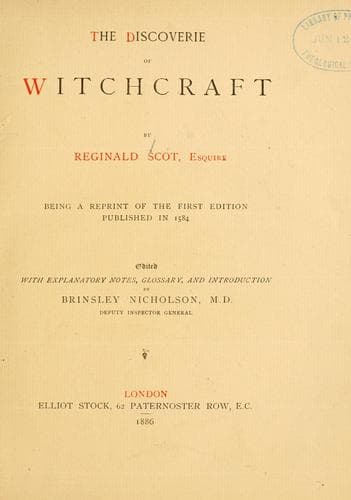
Demonology -- Early works to 1800; Magic -- Early works to 1800; Witchcraft -- Early works to 1800
Howbeit, the godlie and learned fathers (as it appeereth) have alwaies
had a speciall care and respect, that they attributed not unto God such
divelish devises; but referred them to him, who indeed is the inventer
and author thereof, though not the personall executioner, in maner
and forme as they supposed: so as the matter of faith was not thereby
by them impeached. But who can assure himselfe not to be deceived in
matters concerning spirits, when the apostles themselves were so far
from knowing them, as even after the resurrection of Christ, having
heard him preach and expound the scriptures, all his life time, they
shewed themselves not onelie ignorant therein, but also to have
misconceived thereof? Did not the apostle _Thomas_ thinke that Christ
himselfe had beene a spirit; until Christ told him plainelie, that a
spirit was no such creature, as had flesh and bones, the which (he
said) _Thomas_ might see to be in him? And for the further certifieng
and satisfieng of his mind, he commended unto him his hands to be
seene, and his sides to be felt. _Thomas_, if the answer be true that
some make hereunto, to wit: that spirits take formes and shapes of
bodies at their pleasure, might have answered Christ, and remaining
unsatisfied might have said; Oh sir, what do you tell me that spirits
have no flesh and bones? Why they can take shapes and formes, and so
perchance have you doone. Which argument all the witchmongers in the
world shall never be able to answere.
♦John. 20, 9.♦
Some of them that mainteine the creation, the transformation, the
transportation, and transubstantiation of witches, object that spirits
are not palpable, though visible, and answer the place by me before
cited: so as the feeling and not the seeing should satisfie _Thomas_.
But he that shall well weigh the text and the circumstances thereof,
shall perceive, that the fault of _Thomas_ his incredulitie was
secondlie bewraied, and condemned, in that he would not trust his owne
eies, nor the view taken by his fellow apostles, who might have beene
thought too credulous in this case, if spirits could take shapes at
their pleasure. Jesus saith to him; Bicause thou hast seene (and not,
bicause thou hast felt) thou beleevest. Item he saith; Blessed are they
that beleeve and see not (and not, they that beleeve and feele not.)
Whereby he noteth that our corporall eies may discerne betwixt a spirit
and a naturall bodie; reprooving him, bicause he so much relied upon
his externall senses, in cases where faith should have prevailed; &
here, in a matter of faith revealed in the word, would not credit the
miracle which was exhibited unto him in most naturall and sensible sort.
♦John. 20, 29.♦
Public-domain text, read in full here on John Shaqi.
Reviews
Reviews
No reviews yet
Be the first to share your thoughts on this work.
Elsewhere in the archive
Join the Discussion
Join the discussion
Sign in to leave a comment or review.
Sign InorCreate an account