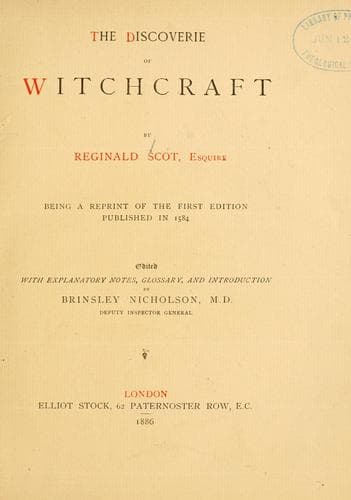
Demonology -- Early works to 1800; Magic -- Early works to 1800; Witchcraft -- Early works to 1800
As for physicall conjectures upon dreames, the scriptures [*]improove
them not: for by them the physicians manie times doo understand
the state of their patients bodies. For some of them come by meanes
of choler, flegme, melancholie, or bloud; and some by love, surfet,
hunger, thirst, &c. _Gallen_ and _Boetius_ were said to deale with
divels, bicause they told so justlie their patients dreames, or rather
by their dreames their speciall diseases. Howbeit, physicall dreames
are naturall, and the cause of them dwelleth in the nature of man. For
they are the inward actions of the mind in the spirits of the braine,
whilest the bodie is occupied with sleepe: for as touching the mind
it selfe, it never sleepeth. These dreames varie, according to the
difference of humors and vapors. There are also casuall dreames, which
(as _Salomon_ saith) come through the multitude of businesse. For as
a looking glasse sheweth the image or figure thereunto opposite: so in
dreames, the phantasie & imagination informes the understanding of such
things as haunt the outward sense. Whereupon the poet saith:
_Somnia ne cures, nam mens humana quod optat,
Dum vigilat sperans, per somnum cernit id ipsum:_
_Regard no dreames, for why the mind
Of that in sleepe a view dooth take,
Which it dooth wish and hope to find,
At such time as it is awake._
♦Eccles. 5.♦
♦[*] [? reproove]♦
♦_Englished by Abraham Fleming._♦
The third Chapter.
_The opinion of divers old writers touching dreames, and how
they varie in noting the causes thereof._
_Synesius_, _Themistius_, _Democritus_, and others grounding themselves
upon examples that chance hath sometimes verified, persuade men, that
nothing is dreamed in vaine: affirming that the hevenlie influencies
doo bring foorth divers formes in corporall matters; and of the same
influencies, visions and dreames are printed in the fantasticall
power, which is instrumentall, with a celestiall disposition meete to
bring foorth some effect, especiallie in sleepe, when the mind (being
free from bodilie cares) may more liberallie receive the heavenlie
influencies, wherby many things are knowne to them sleeping in dreames,
which they that wake cannot see. _Plato_ attributeth them to the
formes and ingendred knowledges of the soule; _Avicen_ to the last
intelligence that moveth the moone, through the light that lighteneth
the fantasie in sleepe; _Aristotle_ to the phantasticall sense;
_Averroës_ to the imaginative; _Albert_ to the influence of superior
bodies.
♦A dissonancie in opinions about dreames.♦
The fourth Chapter.
_Against interpreters of dreames, of the ordinarie cause of
dreames, Hemingius his opinion of diabolicall dreames, the
interpretation of dreames ceased._
Public-domain text, read in full here on John Shaqi.
Reviews
Reviews
No reviews yet
Be the first to share your thoughts on this work.
Elsewhere in the archive
Join the Discussion
Join the discussion
Sign in to leave a comment or review.
Sign InorCreate an account