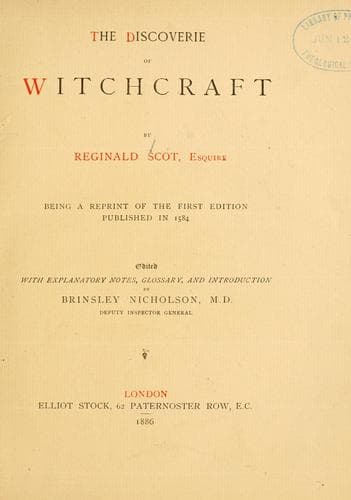
Demonology -- Early works to 1800; Magic -- Early works to 1800; Witchcraft -- Early works to 1800
Of such as allow this follie, I can commend _Plinie_ best, who saith,
that the operation of these auguries is as we take them. For if we take
them in good part, they are signes of good lucke; if we take them in
ill part, ill lucke followeth; if we neglect them, and wey them not,
they doo neither good nor harme. _Thomas_ of _Aquine_ reasoneth in this
wise; The starres, whose course is certeine, have greater affinitie
and communitie with mans actions, than auguries; and yet our dooings
are neither directed nor proceed from the starres. Which thing also
_Ptolome_ witnesseth, saieng; _Sapiens dominabitur astris_, A wiseman
overruleth the starres.
♦_Plin. lib. natural. hist. 28. cap. 2._♦
♦_Tho Aquin. lib. de sortib._♦
The 18. Chapter.
_Fond distinctions of the heathen writers, concerning augurie._
The heathen made a distinction betweene divine, naturall, and casuall
auguries. Divine auguries were such, as men were made beleeve were
done miraculouslie, as when dogs spake; as at the expulsion of
_Tarquinius_ out of his kingdome; or when trees spake, as before the
death of _Cæsar_; or when horsses spake, as did a horsse, whose name
was _Zanthus_. Manie learned christians confesse, that such things
as may indeed have divine cause, may be called divine auguries; or
rather forewarnings of God, and tokens either of his blessings or
discontentation: as the starre was a token of a safe passage to the
magicians that sought Christ; so was the cockcrowing an augurie to
_Peter_ for his conversion. And manie such other divinations or
auguries (if it be lawfull so to terme them) are in the scriptures to
be found.
♦_C. Epidius._
_Homer. Iliad. 19._♦
The 19. Chapter.
_Of naturall and casuall augurie, the one allowed, and the
other disallowed._
Naturall augurie is a physicall or philosophicall observation; bicause
humane and naturall reason may be yeelded for such events: as if one
heare the cocke crow manie times together, a man may ghesse that
raine will followe shortlie; as by the crieng of rooks, and by their
extraordinarie using of their wings in their flight, bicause through a
naturall instinct, provoked by the impression of the heavenlie bodies,
they are mooved to know the times, according to the disposition of the
weather, as it is necessarie for their natures. And therefore _Jeremie_
saith; _Milvus in cœlo cognovit tempus suum_. The physician may argue
a strength towards in his patient, when he heareth him neeze twise,
which is a naturall cause to judge by, and conjecture upon. But sure
it is meere casuall, and also verie foolish and incredible, that by
two neezings, a man should be sure of good lucke or successe in his
businesse; or by meeting of a tode, a man should escape a danger, or
atchieve an enterprise, &c.
The xx. Chapter.
Public-domain text, read in full here on John Shaqi.
Reviews
Reviews
No reviews yet
Be the first to share your thoughts on this work.
Elsewhere in the archive
Join the Discussion
Join the discussion
Sign in to leave a comment or review.
Sign InorCreate an account