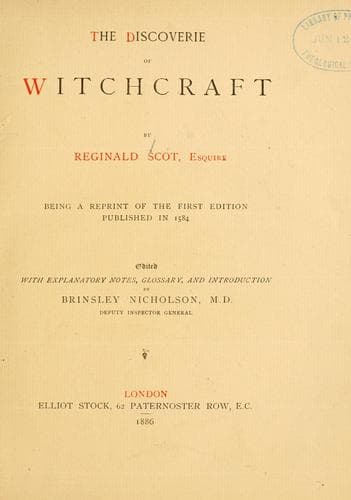
Demonology -- Early works to 1800; Magic -- Early works to 1800; Witchcraft -- Early works to 1800
And for so much as the mightie helpe themselves together, and the
poore widowes crie, though it reach to heaven, is scarse heard here
upon earth: I thought good (according to my poore abilitie) to make
intercession, that some part of common rigor, and some points of hastie
judgement may be advised upon. For the world is now at that stay (as
Brentius in a most godlie sermon in these words affirmeth) that even
as when the heathen persecuted the christians, if anie were accused
to beleeve in Christ, the common people cried _Ad leonem_: so now, if
anie woman, be she never so honest, be accused of witchcraft, they crie
_Ad ignem_. What difference is betweene the rash dealing of unskilfull
people, and the grave counsell of more discreet and learned persons,
may appeare by a tale of Danæus his owne telling; wherein he opposeth
the rashnes of a few townesmen, to the counsell of a whole senate,
preferring the follie of the one, before the wisdome of the other.
♦Eccl[us.] 35, 15.♦
At Orleance on Loyre (saith he) there was a manwitch, not only taken
and accused, but also convicted and condemned for witchcraft, who
appealed from thence to the high court of Paris. Which accusation the
senate sawe insufficient, and would not allow, but laughed thereat,
lightlie regarding it; and in the end sent him home (saith he) as
accused of a frivolous matter. And yet for all that, the magistrats of
Orleance were so bold with him, as to hang him up within short time
after, for the same or the verie like offense. In which example is to
be seene the nature, and as it were the disease of this cause: wherein
(I saie) the simpler and undiscreeter sort are alwaies more hastie &
furious in judgements, than men of better reputation and knowledge.
Nevertheles, Eunichius saith, that these three things; to wit, what is
to be thought of witches, what their incantations can doo, and whether
their punishment should extend to death, are to be well considered.
And I would (saith he) they were as well knowne, as they are rashlie
beleeved, both of the learned, and unlearned. And further he saith,
that almost all divines, physicians and lawyers, who should best know
these matters, satisfieng themselves with old custome, have given too
much credit to these fables, and too rash and unjust sentence of death
upon witches. But when a man pondereth (saith he) that in times past,
all that swarved from the church of Rome were judged heretikes; it is
the lesse marvell, though in this matter they be blind and ignorant.
Public-domain text, read in full here on John Shaqi.
Reviews
Reviews
No reviews yet
Be the first to share your thoughts on this work.
Elsewhere in the archive
Join the Discussion
Join the discussion
Sign in to leave a comment or review.
Sign InorCreate an account