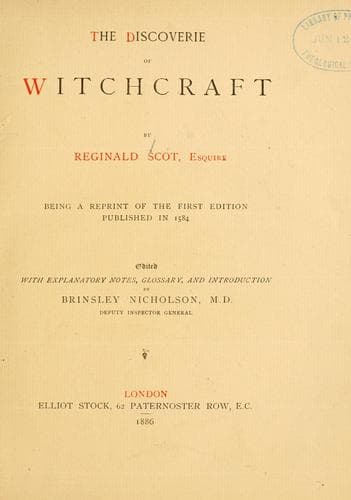
Demonology -- Early works to 1800; Magic -- Early works to 1800; Witchcraft -- Early works to 1800
Of the possessed with devils. pag. 513.
That we being not throughlie informed of the nature of divels and
spirits, must satisfie our selves with that which is dilivered us
in the scriptures touching the same, how this word divell is to be
understood both in the singular & plurall number, of the spirit of God
and the spirit of the divell, of tame spirits, of Ahab. pag. 514.
Whether spirits and soules can assume bodies, and of their creation and
substance, wherein writers doo extreamelie contend and varie.
pag. 516.
Certeine popish reasons concerning spirits made of aier, of daie divels
and night divels, and why the divell loveth no salt in his meate.
pag. 517.
That such divels as are mentioned in the scriptures, have in their
names their nature and qualities expressed, with instances thereof.
pag. 518.
Diverse names of the divell, whereby his nature and disposition is
manifested. pag. 520.
That the idols or gods of the Gentiles are divels, their diverse
names, and in what affaires their labours and authorities are
emploied, wherein also the blind superstition of the heathen people is
discovered. pag. 521.
Of the Romans cheefe gods called _Dii selecti_, and of other heathen
gods, their names and offices. pag. 523.
Of diverse gods in diverse countries. pag. 525.
Of popish provinciall gods, a comparison betweene them and heathen
gods, of physicall gods, and of what occupation everie popish god is.
pag. 526.
A comparison betweene the heathen and papists, touching their excuses
for idolatrie. pag. 529.
The conceipt of the heathen and the papists all one in idolatrie, of
the councell of Trent, a notable storie of a hangman arraigned after
he was dead and buried, &c. pag. 530.
A confutation of the fable of the hangman, of manie other feined and
ridiculous tales and apparitions, with a reproofe thereof. pag. 532.
A confutation of Johannes Laurentius, and of manie others, mainteining
these fained and ridiculous tales and apparitions, & what driveth them
awaie; of Moses and Helias appearance in Mount Thabor. pag. 534.
A confutation of assuming of bodies, and of the serpent that seduced
Eve. pag. 536.
The objection concerning the divels assuming of the serpents bodie
answered. pag. 537.
Public-domain text, read in full here on John Shaqi.
Reviews
Reviews
No reviews yet
Be the first to share your thoughts on this work.
Elsewhere in the archive
Join the Discussion
Join the discussion
Sign in to leave a comment or review.
Sign InorCreate an account