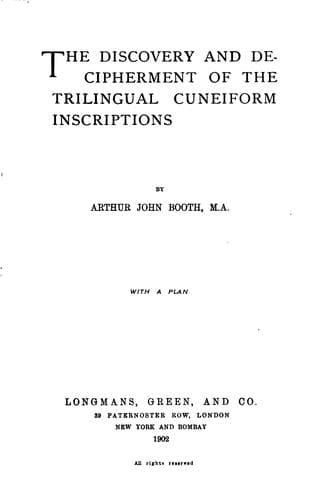
The discovery and decipherment of the trilingual cuneiform inscriptionsBooth, Arthur John
History
The discovery and decipherment of the trilingual cuneiform inscriptions
Booth, Arthur John
Achaemenian inscriptions; Cuneiform inscriptions
We have now given an account of this once famous discovery and the
results that were first attained. We have credited Grotefend with
having found correct, or at least nearly correct, values for twelve
characters; and the achievement may be allowed to merit the fame it
still confers upon its ingenious author. Each step in the process now
appears simple enough, and it is not easy for us to estimate the full
magnitude of the difficulties he surmounted. They can indeed only be
realised by remembering how completely a man like Münter had failed.
Yet it is exceedingly curious to consider how so ingenious a person
was baffled when he might seem to be on the point of farther success.
Grotefend was harassed by the continued recurrence of the two words he
transliterated ‘Bun Akeotscheschoh.’ There was, of course, no punctuation
to guide the translator, and he constantly connected these two words
together. His translation usually ran: ‘Darii regis [filius] stirps
mundi rectoris.’[321] He was quite satisfied from the beginning that
‘bun’ signified ‘stirps,’ and in the Pehlevi inscription, which was his
constant model, he had before him the very appropriate reading ‘stirps
Achaemenis.’ No phrase, he well knew, was more likely to appear in these
inscriptions than this very one. He had already arrived at the first
three letters of this word, _a_, _k_, _e_ or _a_, and it is strange the
suspicion never entered his mind that the rest of his transliteration
should be modified in accordance with the apparently inevitable
conclusion that the mysterious word was in fact ‘Achaemenian.’ This is
all the more remarkable from another consideration. De Sacy had expressly
exhorted him to keep a look out for ‘Ormuzd,’ which was certain to occur
frequently in the cuneiform, as it did in the Sassanian inscriptions. In
the Le Bruyn No. 131 he found a word which, according to his alphabet
read ‘euroghde’; and in this with singular acuteness he fancied he
detected some trace of Ormuzd.[322] But he identified the first portion
of the word with the Zend of Anquetil ‘éhoré,’ and read for the whole
‘Oromasdis cultor.’[323] Yet, according to his own transliteration the
word gave him _a_ _u_ _r_ . . _d_ _a_,
𐎠 · 𐎢 · 𐎼 · 𐎶 · 𐏀 · 𐎭 · 𐎠·
_a_ _u_ _r_ . . _d_ _a_.
Public-domain text, read in full here on John Shaqi.
Reviews
Reviews
No reviews yet
Be the first to share your thoughts on this work.
Elsewhere in the archive
Join the Discussion
Join the discussion
Sign in to leave a comment or review.
Sign InorCreate an account