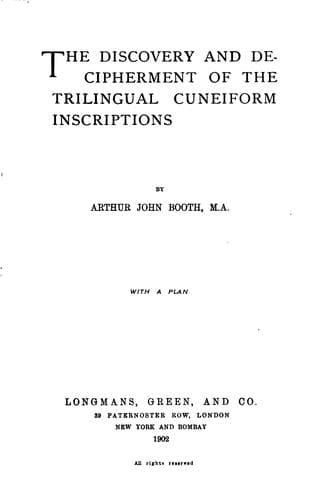
The discovery and decipherment of the trilingual cuneiform inscriptionsBooth, Arthur John
History
The discovery and decipherment of the trilingual cuneiform inscriptions
Booth, Arthur John
Achaemenian inscriptions; Cuneiform inscriptions
Ceci [est] I am
Darius roi Darius the great King,
divin, roi
des rois, King of Kings,
roi des provinces, King of countries
qui produisent les braves, which consist of many races,
roi du monde excellent king of this great earth
[et] divin; redoutable, afar and near,
protecteur: fils
du Goshtasp Achéménide. son of Hystaspes the Achaemenian.
A comparison of the two translations with the final version will show
at a glance how vastly superior Burnouf’s rendering was to that of his
predecessor. Not the least important of his contributions to the work of
translation was the identification of the names of some of the provinces
of Darius, which are contained in the I inscription. We have already
observed that Grotefend had attempted a translation of this inscription
in 1832;[425] and in 1836 he again drew attention to the circumstance
that it contained a series of geographical names. The list included no
less than twenty-four proper names, some of which were entirely beyond
Burnouf’s power to decipher; but he made an attempt to read sixteen,
and out of these eight were correct. He thus added Persia, Media,
Babylon, Arabia, Cappadocia, Sarangia, Bactria and Sogdiana to the names
deciphered from the cuneiform;[426] and we have seen how nearly he
arrived at four more—Athura (or Assyria), Armenia, Ionia[427] and Parthia.
Among his contributions to a knowledge of the grammar, he pointed out
that the change of Grotefend’s _o_ into _m_ brought the accusative
singular into line with the Zend and Sanscrit; the genitive _aha_ is also
found in Zend, and both languages alike use it as a dative. A nominative
ending in _oh_ has also its counterpart in the Zend termination in _o_.
He indicated the apparent barbarism that treats the nominative case as
inherent in the word itself; so that the case-ending is appended to it
without modification, as if we wrote ‘dominus-um’ for ‘dominum,’ or
‘dominus-i’ for ‘domini.’[428]
Public-domain text, read in full here on John Shaqi.
Reviews
Reviews
No reviews yet
Be the first to share your thoughts on this work.
Elsewhere in the archive
Join the Discussion
Join the discussion
Sign in to leave a comment or review.
Sign InorCreate an account