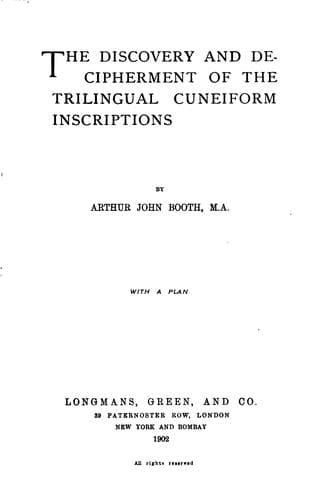
The discovery and decipherment of the trilingual cuneiform inscriptionsBooth, Arthur John
History
The discovery and decipherment of the trilingual cuneiform inscriptions
Booth, Arthur John
Achaemenian inscriptions; Cuneiform inscriptions
Rawlinson’s revised translation of the inscriptions published two years
before by Lassen forms the concluding chapter of his Memoir. We have
already had occasion to contrast the merits and demerits of the two
translators. Rawlinson’s transliteration presents an entirely modern
appearance in consequence of the correctness of the values of so many
signs. There are still a few errors, owing chiefly to the prolongation
of the final syllable in such words as ‘thatiya,’ ‘tyaia,’ and others,
an error already signalled by Hincks. But these are of small importance.
As regards the translations, he brought from the study of the Behistun
record a knowledge of the language that no one else then possessed, and
he was able at once to resolve difficulties that had baffled all previous
attempts. Such expressions as ‘generosus [sum]’ finally disappeared for
the correct rendering ‘he says.’ Sentences that were hitherto entirely
misapprehended now appear in their correct form. ‘The son of Arcis’ gives
place to ‘the son of a Persian, an Arian of Arian descent.’ The last
paragraph of the same inscription is satisfactorily explained. Even where
he fell short of success, as in the end of the I inscription, he made
important contributions to the elucidation of intricate passages.
Rawlinson added the inscription on the Venice vase, not known to Lassen.
It had been recently published by Longpérier in the ‘Revue Archéologique’
(1844), who thought it should be referred to Artaxerxes I. Rawlinson
translated it ‘Artaxerxes the King,’ and assigned it to Artaxerxes Ochus.
Opinion has since been divided upon the subject; Spiegel and Menant
follow Longpérier; Oppert and Weissbach follow Rawlinson.
Public-domain text, read in full here on John Shaqi.
Reviews
Reviews
No reviews yet
Be the first to share your thoughts on this work.
Elsewhere in the archive
Join the Discussion
Join the discussion
Sign in to leave a comment or review.
Sign InorCreate an account