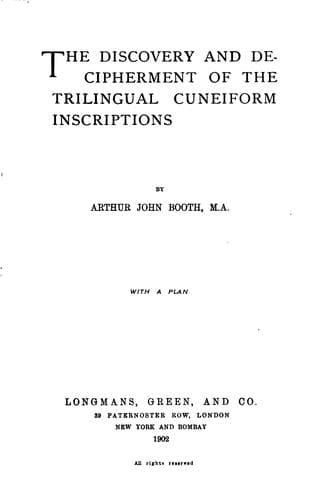
The discovery and decipherment of the trilingual cuneiform inscriptionsBooth, Arthur John
History
The discovery and decipherment of the trilingual cuneiform inscriptions
Booth, Arthur John
Achaemenian inscriptions; Cuneiform inscriptions
We have already said that in 1859 Oppert had abandoned the hypothesis
that the language of the second column was introduced by the Scythic
hordes who were expelled by Cyaxares. He recognised that it was
connected with the ancient Akkadian, and could not, therefore, be a
new importation, but an original native dialect. He considered that
the Median name itself is Turanian and related to ‘Mada,’ the Akkadian
for ‘land.’ He thought it is clear from Herodotus that the six tribes
who composed the Median nation were not all of the same origin. The
dominant caste were, he still held, of the same Indo-European race as
the Persians, but a large part of the population were Turanians, and the
language of the second column was that of the agricultural and nomadic
tribes of Media, especially those of the north. He accordingly gave it
the name of Medo-Scythic to distinguish it from the Aryan Median of the
classical writers.
This very tenable hypothesis he, however, abandoned in its turn, and
advanced one much more hazardous. He relies upon a fable of Herodotus
to show that the Aryans occupied the country from a much earlier period
than has been commonly supposed, and did not, therefore, make their
first appearance with Dejoces. Both Aryans and Turanians, he now thinks,
were long settled together in the same country, and it is impossible to
say which of the two were the first comers, though he inclines to give
precedence to the Aryans. The various tribes were upon an equality,
sometimes the Turanian and sometimes the Aryan gaining the ascendency. He
considers the former were known as the Medes, a word essentially Turanian
in its origin, while the others retained their proper designation of
Aryans. He holds that the Median dynasty of Dejoces was Turanian. He
carefully analyses the names of their kings, and he has succeeded in
affording a fresh illustration of the peculiar power of philology to
prove any thesis whatever, when employed by a skilful manipulator. Not
many years before, he laid it down as self-evident that these same names
were pure Aryan.[694] Now it becomes no less apparent that they are pure
Turanian. The dynasty of Dejoces marks the ascendency of the Turanian
Medes, and the language of the second column is that which was spoken
by them. He accordingly drops his previous qualification of Scythic,
and gives it simply the name of Median. The rise of the Persian power
enabled the Aryan Medes to recover the position they had temporarily
lost, and hence all the names that occur from the time of Darius clearly
belong to that race. Mada became a geographical name which embraced
the whole population of the country now under an Aryan aristocracy,
and Herodotus was therefore fully justified in speaking of the Medes
and Persians as one in speech and descent. The theory of the Turanian
origin of the Median dynasty has been almost universally abandoned.[695]
The attack upon it was led by the Jesuit scholar Delattre,[696] and
Public-domain text, read in full here on John Shaqi.
Reviews
Reviews
No reviews yet
Be the first to share your thoughts on this work.
Elsewhere in the archive
Join the Discussion
Join the discussion
Sign in to leave a comment or review.
Sign InorCreate an account