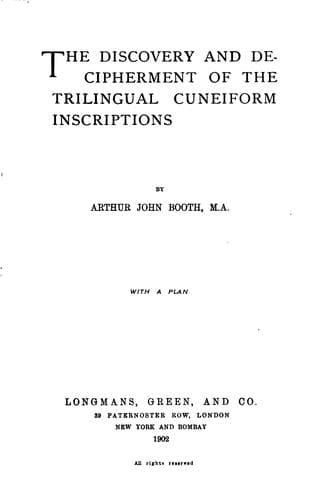
The discovery and decipherment of the trilingual cuneiform inscriptionsBooth, Arthur John
History
The discovery and decipherment of the trilingual cuneiform inscriptions
Booth, Arthur John
Achaemenian inscriptions; Cuneiform inscriptions
There is little doubt that it and kindred languages were extensively
spoken in early times throughout Susiana and the lower valley of
the Euphrates down to the Persian Gulf. Its connection with the Old
Susian has never been doubted. Lenormant, Oppert, Sayce and Hommel
have testified to its more distant relationship with the Akkadian, the
primitive language of Babylonia. Weisbach is naturally more sceptical,
for in 1890 he had scarcely emancipated himself from the heresy
of Halévy, who doubted the existence of Akkadian as an independent
language.[702] Sayce and his disciple Hommel added the speech of the
Kossaeans to the same group.[703] They were indeed disposed to create a
new family of languages which they called Alarodian,[704] and included
within it the Elamite, embracing New and Old Susian, Kassite,[705]
Hittite[706] and Vannic.[707] They considered that the nearest modern
representative of this language is the Georgian and Basque, an opinion
which, it will be remembered, had somewhat fascinated both Westergaard
and Rawlinson. The propriety of this classification was, however, doubted
by Lenormant, and it has never been satisfactorily established.[708]
CHAPTER VI
DECIPHERMENT OF THE THIRD OR BABYLONIAN COLUMN—HINCKS AND RAWLINSON—A.D.
1846-1851
The task of deciphering the Third or Babylonian Column led to far more
important results, and cannot be so briefly summarised. The earliest
inscriptions found in Babylonia were observed to consist of two
well-marked styles of writing the cuneiform character. One of these
styles was to be seen on the Michaux Stone, published in the Collection
of Millin. The other occurs on the numerous bricks that were picked up
upon the ancient site of Babylon, and on a number of cylinders. But the
most remarkable example of this style was found in the long inscription
obtained by Sir Harford Jones and published by the East India Company.
The first style is by far the simplest, and it is known as the Cursive or
New Babylonian; the other is so elaborate that Grotefend called it the
‘Zierschrift’;[709] but it is generally described as the Lapidary or Old
Babylonian. All the early scholars were struck by the close similarity of
the writing in the third column at Persepolis to the first or simplest
form of Babylonian. Münter went a step farther, and pointed out that the
similarity extended to the Old Babylonian of the brick inscriptions. In
the collection of inscriptions made by Mr. Rich, he thought he discerned
three well-marked varieties of writing; but he was able to announce that
Grotefend, after a careful comparison, considered that they were all
closely related to one another and to the third Persepolitan.[710] It was
soon recognised that there are in fact only two varieties of Babylonian,
and what Mr. Rich supposed to be a third is due only to the vagaries of
the scribe, or, as Rawlinson explained, it ‘arises from the distortion of
oblique elongation.’[711] It was long, however, before the identification
Public-domain text, read in full here on John Shaqi.
Reviews
Reviews
No reviews yet
Be the first to share your thoughts on this work.
Elsewhere in the archive
Join the Discussion
Join the discussion
Sign in to leave a comment or review.
Sign InorCreate an account