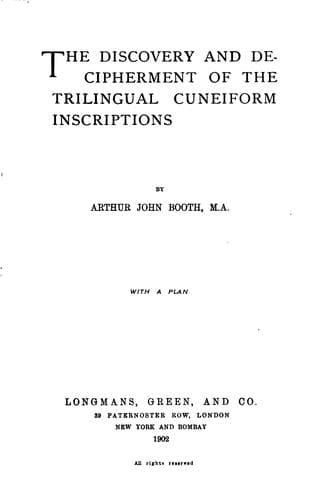
The discovery and decipherment of the trilingual cuneiform inscriptionsBooth, Arthur John
History
The discovery and decipherment of the trilingual cuneiform inscriptions
Booth, Arthur John
Achaemenian inscriptions; Cuneiform inscriptions
What would have been more natural than to give the commission
to M. Flandin, whose enterprise in such matters had already been so
conspicuously illustrated? Nothing, however, could be farther from
their intentions. They had no notion of foregoing the luxury of feeling
aggrieved with the English soldier whose energy, like his genius, so far
out-soared their own. Rawlinson was, we submit, fully justified in the
course he adopted. He had obtained his copy at great personal sacrifice;
no one in Europe was so qualified to accomplish the task of decipherment
as himself, and the eighteen months he devoted to the task was not
excessive. The subsequent delay in publication was incident to the nature
of the work itself, for which he was not responsible.
He, however, lost no time in placing the general results at which he had
arrived before the public. On January 19 and February 16, 1850, he read
papers before the Asiatic Society ‘On the Inscriptions of Assyria and
Babylon,’ and these, with a few additional notes, were published in March
of that year.
He tells us he had found more than eighty proper names in the trilingual
inscriptions, including those in the Behistun; and ‘by a careful
comparison of the duplicate forms of writing’ them in the Persian and
Babylonian columns he had been able, by means of the former, which were
known, to determine the values of about a hundred Babylonian characters.
The next step was by a collation of the inscriptions to ascertain ‘the
homophones of each known alphabetical power.’ By this means he ‘added
nearly fifty characters to those previously known through the Persian
key.’ He confessed that his knowledge of the Babylonian characters was
at present limited to these one hundred and fifty characters.[818] From
the direction of his studies we may infer that these signs were chiefly
taken from the trilingual inscriptions; and in that case they would be
practically exhaustive; but they would amount to less than one half
of those in general use in the Assyrian text.[819] The same process
of comparison with the Persian translation enabled him to draw up ‘a
list of about two hundred Babylonian words of which we know the sound
approximately and the meaning certainly.’ But in addition to these, he
was able, by ‘an extensive comparison of similar or cognate phrases, to
add about two hundred meanings certainly, and a hundred more, probably,
to the vocabulary already obtained through the Babylonian translation.’
He was thus acquainted with the meaning of about five hundred out of a
vocabulary which he estimated as containing five thousand words.[820]
These words, he explains, ‘are almost all found either in their full
integrity or subjected to some slight modification in Assyrian’; and
they enabled him ‘to arrive at a pretty correct notion of the general
purport of the phrases in which they occur.’ Although his vocabulary was
still limited to one-tenth of the vocabulary, it embraced ‘all the most
Public-domain text, read in full here on John Shaqi.
Reviews
Reviews
No reviews yet
Be the first to share your thoughts on this work.
Elsewhere in the archive
Join the Discussion
Join the discussion
Sign in to leave a comment or review.
Sign InorCreate an account