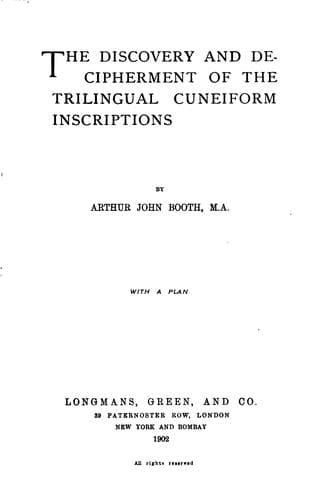
The discovery and decipherment of the trilingual cuneiform inscriptionsBooth, Arthur John
History
The discovery and decipherment of the trilingual cuneiform inscriptions
Booth, Arthur John
Achaemenian inscriptions; Cuneiform inscriptions
peculiarity most necessary to emphasise is that in a vast majority of
cases the pronunciation of the ideogram has no relation whatever to the
name of the object it represents, nor, when it has a syllabic power,
to the phonetic value of the syllable. Rawlinson, however, did good
service in the present Memoir by laying down the first rudiments of
the grammar, a branch of the subject that Hincks subsequently did much
to elucidate; and he was also the first to bring into prominence the
polyphonic character of the language. Hincks had indeed remarked that
‘many characters admit of two or more kindred values’; but Rawlinson
farther shows that ‘certain characters represent two entirely dissimilar
sounds—sounds so dissimilar that they cannot be brought into relation
with each other.’ He gives as an example the sign for the vowel _a_,
which also conveys the sound of ‘bar.’
But the great distinction of Rawlinson lay in his unequalled power of
translation. Large numbers of Assyrian inscriptions were now before
the world. The ‘Monument de Khorsabad’ had appeared in 1848; Layard’s
collection followed in 1849, and included the inscription on the Black
Obelisk found in 1846. So far only a few words had been made out with
more or less of accuracy; but nothing had yet been done in the way of
a connected translation. The few lines of the Khorsabad inscription
which Hincks attempted in the Addenda to his paper (Feb. 26, 1850) had
not as yet appeared.[821] Rawlinson, however, observed that many of the
common expressions used at Behistun were adopted almost verbatim from
the Assyrian annals; and it was the discovery of these known passages in
the Assyrian inscriptions that first encouraged him to undertake their
translation. He disclaimed all pretensions to be ‘a complete master
of the Assyrian language’; and he still speaks of it as to a great
extent unintelligible. ‘The first outwork,’ he says, ‘has been carried
in a hitherto impregnable position, and that is all’ Indeed he is so
discouraged by the difficulty of the task that he is sometimes disposed
‘to abandon the study altogether in utter despair of arriving at any
satisfactory result.’ In consequence of the profusion of ideograms
in proper names, he finds that their ‘pronunciation is a matter of
exceeding difficulty, nay, as I think, of absolute impossibility’;
and it was in this department that he achieved the least success. He,
however, passes in review many of the principal inscriptions that were
then known, and analyses the contents of each.[822] He begins with the
earliest in date, the one taken from the North West Palace at Nineveh,
which he ascribes to King Assur-adan-pal—really Assur-natsir-pal. He
passes on to the inscription of his successor, whom he calls Temenbar
II. (really Salmaneser II.), which covers the Black Obelisk, and it is
to it that he devotes the largest share of attention.[823] His analysis,
partly a verbal translation and partly a summary, fills no less than
Public-domain text, read in full here on John Shaqi.
Reviews
Reviews
No reviews yet
Be the first to share your thoughts on this work.
Elsewhere in the archive
Join the Discussion
Join the discussion
Sign in to leave a comment or review.
Sign InorCreate an account