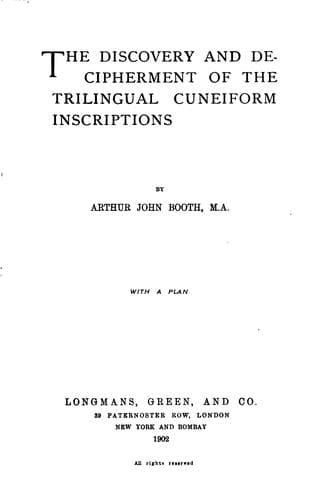
The discovery and decipherment of the trilingual cuneiform inscriptionsBooth, Arthur John
History
The discovery and decipherment of the trilingual cuneiform inscriptions
Booth, Arthur John
Achaemenian inscriptions; Cuneiform inscriptions
In 1849, however, he contributed two pamphlets which it is admitted
were of greater importance. In the first, which appeared on September
14, he undertook a transcription of the Babylonian column of the Elvend
inscription with translation and analysis. He succeeded, we are told, in
separating the Babylonian signs correctly, so that each group could be
compared word for word with the Persian. In his analysis he is said to
have justified the values he attributed to each sign, and the meaning
he attached to each word. He regarded the signs as purely consonantal,
and sought to bring them all into relation with the twenty-two Hebrew
letters. He seems to have thought that some of the signs are capable of
division: one portion fixed, representing the consonant, and the other
a variable appendix indicating the vowel. In the second pamphlet, dated
November 27, he treated the Persepolitan inscriptions in the same manner,
but with a growing suspicion that the Assyrian letters might after all
turn out to be syllabic.[850] By this means he arrived at the consonantal
sound of a hundred and twenty signs which M. Menant says were generally
correct. When Rawlinson published his Syllabarium, in 1851 (two years
later) De Saulcy observed that sixty-eight of these one hundred and
twenty signs received the same values. Not satisfied with this success,
he seems actually to have thought that Rawlinson had borrowed them
without acknowledgment from him: ‘J’avais donc lu et publié avant M.
Rawlinson soixante-huit des valeurs exactes publiées par lui; il eût
été de bon goût, peut-être, de prendre, ne fût-ce qu’une seule fois, la
peine de citer mon nom.’[851] It is, of course, quite impossible to admit
the claims made on his behalf. We have not been able to see the signs
to which reference is made, but it is quite certain that, in September
1849, there were not sixty-eight signs in the Persepolitan inscription
still remaining unknown either to Hincks or Rawlinson. It must be
recollected that De Saulcy’s pamphlets appeared more than two years after
Hincks had already accomplished a somewhat similar classification with
a considerable measure of success; and therefore after the consonantal
values of a large number of signs had long been correctly ascertained.
On the other hand, the earlier papers of Hincks were quite accessible to
De Saulcy, and we learn from Mohl that they were well known in France a
year before the appearance of his two pamphlets.[852] ‘What,’ asks M.
Menant, ‘did Rawlinson owe to De Saulcy’s labours on the Assyrian text?
It is impossible to say,’ he answers, ‘for Rawlinson has not given an
account of his preliminary studies.’[853] The answer is, however, much
simpler than this. Rawlinson owes nothing to De Saulcy, for the reason
that his transliteration of the Behistun inscription was accomplished
before he left Bagdad in October 1849,[854] and therefore before it
was possible for him to receive even the earliest of De Saulcy’s
pamphlets.
Public-domain text, read in full here on John Shaqi.
Reviews
Reviews
No reviews yet
Be the first to share your thoughts on this work.
Elsewhere in the archive
Join the Discussion
Join the discussion
Sign in to leave a comment or review.
Sign InorCreate an account