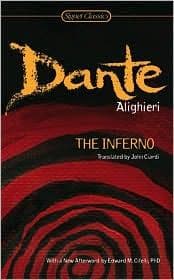
The Divine Comedy of Dante Alighieri: The InfernoDante Alighieri
ReligionJewish
The Divine Comedy of Dante Alighieri: The Inferno
Dante Alighieri
Epic poetry, Italian -- Translations into English; Hell; Italian poetry -- To 1400 -- Translations into English
[729] _Focara_: The name of a promontory near Cattolica, subject to
squalls. The victims were never to double the headland.
[730] _Curio_: The Roman Tribune who, according to Lucan--the incident
is not historically correct--found Cæsar hesitating whether to cross the
Rubicon, and advised him: _Tolle moras: semper nocuit differre paratis_.
'No delay! when men are ready they always suffer by putting off.' The
passage of the Rubicon was counted as the beginning of the Civil
War.--Curio gets scant justice, seeing that in Dante's view Cæsar in all
he did was only carrying out the Divine purpose regarding the Empire.
[731] _Mosca_: In 1215 one of the Florentine family of the Buondelmonti
jilted a daughter of the Amidei. When these with their friends met to
take counsel touching revenge for the insult, Mosca, one of the Uberti
or of the Lamberti, gave his opinion in the proverb, _Cosa fatta ha
capo_: 'A thing once done is done with.' The hint was approved of, and
on the following Easter morning the young Buondelmonte, as, mounted on a
white steed and dressed in white he rode across the Ponte Vecchio, was
dragged to the ground and cruelly slain. All the great Florentine
families took sides in the feud, and it soon widened into the civil war
between Florentine Guelf and Ghibeline.
[732] _Bertrand de Born_: Is mentioned by Dante in his Treatise _De
Vulgari Eloquio_, ii. 2, as specially the poet of warlike deeds. He was
a Gascon noble who used his poetical gift very much to stir up strife.
For patron he had the Prince Henry, son of Henry II. of England. Though
Henry never came to the throne he was, during his father's lifetime,
crowned as his successor, and was known as the young King. After the
death of the Prince, Bertrand was taken prisoner by the King, and,
according to the legend, was loaded with favours because he had been so
true a friend to his young master. That he had a turn for fomenting
discord is shown by his having also led a revolt in Aquitaine against
Richard I.--All the old MSS. and all the earlier commentators read _Re
Giovanni_, King John; _Re Giovane_, the young King, being a
comparatively modern emendation. In favour of adopting this it may be
mentioned that in his poems Bertrand calls Prince Henry _lo Reys joves_,
the young King; that it was Henry and not John that was his friend and
patron; and that in the old _Cento Novelle_ Henry is described as the
young King: in favour of the older reading, that John as well as his
brother was a rebel to Henry; and that the line is hurt by the change
from _Giovanni_ to _Giovane_. Considering that Dante almost certainly
wrote _Giovanni_ it seems most reasonable to suppose that he may have
confounded the _Re Giovane_ with King John.
[733] _From what, etc._: The spinal cord, as we should now say, though
Dante may have meant the heart.
Public-domain text, read in full here on John Shaqi.
Reviews
Reviews
No reviews yet
Be the first to share your thoughts on this work.
Elsewhere in the archive
Join the Discussion
Join the discussion
Sign in to leave a comment or review.
Sign InorCreate an account