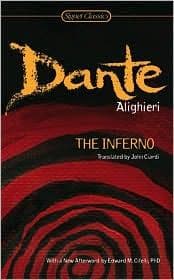
The Divine Comedy of Dante Alighieri: The InfernoDante Alighieri
ReligionJewish
The Divine Comedy of Dante Alighieri: The Inferno
Dante Alighieri
Epic poetry, Italian -- Translations into English; Hell; Italian poetry -- To 1400 -- Translations into English
[35] It opens with Brunetto's being lost in the forest of Roncesvalles,
and there are some other features of resemblance--all on the
surface--between his experience and Dante's.
[36] G. Villani, viii. 10. Latini died in 1294. Villani gives the old
scholar a very bad moral character.
[37] _Inf._ xv. 84.
[38] We may, I think, assume the _Vita Nuova_ to have been published
some time between 1291 and 1300; but the dates of Dante's works are far
from being ascertained.
[39] So long as even Italian critics are not agreed as to whether the
title means _New Life_, or _Youth_, I suppose one is free to take his
choice; and it seems most natural to regard it as referring to the new
world into which the lover is transported by his passion.
[40] As, indeed, Boccaccio, _Vita di Dante_, expressly says was the
case.
[41] In this adopting a device frequently used by the love-poets of the
period.--Witte, _Dante-Forschungen_, vol. ii. p. 312.
[42] The _Vita Nuova_ contains some thirty poems.
[43] See Sir Theodore Martin's Introduction to his Translation of _Vita
Nuova_, page xxi.
[44] In this matter we must not judge the conduct of Dante by English
customs.
[45] _Donne, ch' avete intelletto d' amore_: Ladies that are acquainted
well with love. Quoted in _Purg._ xxiv. 51.
[46] Beatrice died in June 1290, having been born in April 1266.
[47] _Purg._ xi. 98.
[48] _Purg._ xxiv. 52.
[49] The date of the _Convito_ is still the subject of controversy, as
is that of most of Dante's works. But it certainly was composed between
the _Vita Nuova_ and the _Comedy_.
There is a remarkable sonnet by Guido Cavalcanti addressed to Dante,
reproaching him for the deterioration in his thoughts and habits, and
urging him to rid himself of the woman who has bred the trouble. This
may refer to the time after the death of Beatrice. See also _Purg._ xxx.
124.
[50] _Convito_ ii. 13.
[51] Some recent writers set his marriage five years later, and reduce
the number of his children to three.
[52] His sister is probably meant by the 'young and gentle lady, most
nearly related to him by blood' mentioned in the _Vita Nuova_.
[53] The difference between the Teutonic and Southern conception of
marriage must be kept in mind.
[54] He describes the weather on the day of the battle with the
exactness of one who had been there (_Purg._ v. 155).
[55] Leonardo Bruni.
[56] _Inf._ xxii. 4.
[57] _Inf._ xxi. 95.
[58] _Conv._ iii. 9, where he illustrates what he has to say about the
nature of vision, by telling that for some time the stars, when he
looked at them, seemed lost in a pearly haze.
[59] The _Convito_ was to have consisted of fifteen books. Only four
were written.
[60] _Wife of Bath's Tale._ In the context he quotes _Purg._ vii. 121,
and takes ideas from the _Convito_.
[61] Dies to sensual pleasure and is abstracted from all worldly affairs
and interests. See _Convito_ iv. 28.
[62] From the last canzone of the _Convito_.
[63] In the _Vita Nuova_.
Public-domain text, read in full here on John Shaqi.
Reviews
Reviews
No reviews yet
Be the first to share your thoughts on this work.
Elsewhere in the archive
Join the Discussion
Join the discussion
Sign in to leave a comment or review.
Sign InorCreate an account