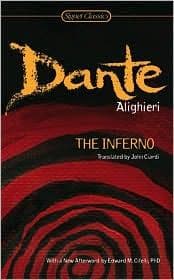
The Divine Comedy of Dante Alighieri: The InfernoDante Alighieri
ReligionJewish
The Divine Comedy of Dante Alighieri: The Inferno
Dante Alighieri
Epic poetry, Italian -- Translations into English; Hell; Italian poetry -- To 1400 -- Translations into English
Her raging lust is still insatiate,
And food but makes it fiercer than it was.
Many a creature[174] hath she ta'en for mate, 100
And more she'll wed until the hound comes forth
To slay her and afflict with torment great.
He will not batten upon pelf or earth;
But he shall feed on valour, love, and lore;
Feltro and Feltro[175] 'tween shall be his birth.
He will save humbled Italy, and restore,
For which of old virgin Camilla[176] died;
Turnus, Euryalus, Nisus, died of yore.
Her through all cities chasing far and wide,
He at the last to Hell will thrust her down, 110
Whence envy[177] first unloosed her. I decide
Therefore and judge that thou hadst best come on
With me for guide;[178] and hence I'll lead thee where
A place eternal shall to thee be shown.
There shalt thou hear the howlings of despair
In which the ancient spirits make lament,
All of them fain the second death to share.
Next shalt thou them behold who are content,
Because they hope some time, though now in fire,
To join the blessed they will win consent. 120
And if to these thou later wouldst aspire,
A soul[179] shall guide thee, worthier far than I;
When I depart thee will I leave with her.
Because the Emperor[180] who reigns on high
Wills not, since 'gainst His laws I did rebel,[181]
That to His city I bring any nigh.
O'er all the world He rules, there reigns as well;
There is His city and exalted seat:
O happy whom He chooses there to dwell!'
And I to him: 'Poet, I thee entreat, 130
Even by that God who was to thee unknown,
That I may 'scape this present ill, nor meet
With worse, conduct me whither thou hast shown,
That I may see Saint Peter's gate,[182] and those
Whom thou reportest in such misery thrown.'
He moved away; behind him held I close.
FOOTNOTES:
[160] _Middle_: In his _Convito_ (iv. 23), comparing human life to an
arch, Dante says that at the age of thirty-five a man has reached the
top and begins to go down. As he was born in 1265 that was his own age
in 1300, the year in which the action of the poem is laid.
[161] _Darksome wood_: A state of spiritual darkness or despair into
which he has gradually drifted, not without fault of his own.
[162] _A hill_: Lower down this hill is termed 'the origin and cause of
all joy.' It is symbolical of spiritual freedom--of the peace and
security that spring from the practice of virtue. Only, as it seems, by
gaining such a vantage-ground can he escape from the wilderness of
doubt--the valley of the shadow of death--in which he is lost.
Public-domain text, read in full here on John Shaqi.
Reviews
Reviews
No reviews yet
Be the first to share your thoughts on this work.
Elsewhere in the archive
Join the Discussion
Join the discussion
Sign in to leave a comment or review.
Sign InorCreate an account