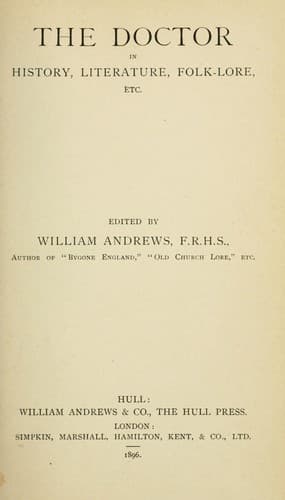
The Doctor in History, Literature, Folk-Lore, Etc.
History
The Doctor in History, Literature, Folk-Lore, Etc.
Literature and medicine; Physicians; Physicians in literature
There is a much more effective, though a somewhat revolting prescription
for "those with abilitie." "Take," says our seventeenth century physician,
"take a sound horse, open his belly alive, take out all his entrayles
quickly, and put the poysoned partie naked into it all save his head,
while the body of the horse retains his naturall heate, and there let him
sweat well." Our author admits that "this may be held a strange course,
but the same reason that teacheth to devide live pullets and pigeons for
plague-sores approveth this way of sweating as most apt to draw to itselfe
all poysons from the heart and principall parts of the patient's body.
But during this time of sweating he must defend his braine by wearing on
his head a quilt." The quilt is to be made by taking a number of dried
herbs, which are to be made into a "grosse powder and quilt them up in
sarsnet or calico, and let it be so big as to cover all the head like a
cap, then binde it on fast with a kerchief." This is called "a Nightcap to
preserve the Brain."
There are also curious prescriptions for the stings of bees and wasps, the
"bitings of spiders," of which he says "the garden ones are the worst." He
tells us that the "flesh of the same beast that biteth, inwardly taken,
helpeth much," and that "outwardly the best thing to be applied is the
flesh of the same beast that did the hurt, pounded in a morter and applied
in manner of a poultis." Here is one about that pretty little animal, the
shrew-mouse: "Now the shrew-mouse is a little kind of a mouse with a long
sharpe snout and a short tayle; it liveth commonly in old ruinous walls.
It biteth also very venomously, and leaveth foure small perforations made
by her foure foreteeth. To cure her biting, her flesh roasted and eaten is
the best inward antidote if it may be had. And outwardly apply her warme
liver and skin if it may be had. Otherwise _Rocket-reeds_ beaten into
powder, and mixed with the bloud of a dog. Or els the teeth of a dead man
made into a fine powder."
The toad comes in for a good share of attention, and Mr. Bradwell gives a
personal anecdote on this subject. He says:--"Myself, while I was a
student at _Cambridge_, was so hurt by the spouting of a venomous humour
from the body of a great toad into my face while I pashed him to death
with a brickbat. Some of the moisture lighted on my right eye, which did
not a little endanger it, and hath made it ever since apt to receive any
flux of Rheume or Inflammation." Some of our readers may think that this
was a fit punishment for having "pashed" the toad to "death with a
brickbat."
Public-domain text, read in full here on John Shaqi.
Reviews
Reviews
No reviews yet
Be the first to share your thoughts on this work.
Elsewhere in the archive
Join the Discussion
Join the discussion
Sign in to leave a comment or review.
Sign InorCreate an account