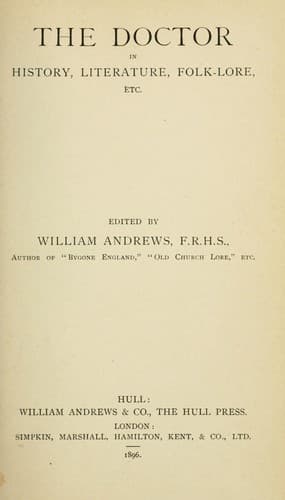
The Doctor in History, Literature, Folk-Lore, Etc.
History
The Doctor in History, Literature, Folk-Lore, Etc.
Literature and medicine; Physicians; Physicians in literature
The treatment was indeed drastic, and we might truly add cruel. Tom Verney
had "a tertian ague and a feaver," and for this he had "only a vomit,
glister, a cordiall, and breathed a vane"--that is, was bled. Another
patient, Sir George Wheler, who had caught a chill after dancing, had all
sorts of "Applications of Blisters and Laudanums," so that his Christmas
dinner at Dr. Denton's cost him "the best part of 100 pounds." For an
eruption in the leg, Sir Ralph Verney was advised to apply a lotion "so
virulent, a drop would fech of the skin when it touched."
Young Edmund Verney was ill in 1657, and writes to his father, "Truly I
might compare my afflictions to Job's. I have taken purges and vomits,
pills and potions, I have been blooded, and I doe not know what I have not
had, I have had so many things." In 1657-58 the epidemic known as "The New
Disease," proved very fatal, and created quite a panic. The treatment
adopted by the doctors may be gathered from a prescription of Dr.
Denton's, one of the most famous physicians of the time. He writes to Sir
Ralph Verney, "I see noe danger of Wm. R., and if he had followed your
advice by taking of a vomit, and if that had not done it, then to have
beene blooded, I beleeved he had beene well ere this." Then he adds "It is
the best thinge and the surest and the quickest he can yet doe, therefore
I pray lett him have one yett. 3 full spoonfulls of the vomitage liquor in
possitt drinke will doe well, and he may abide 4 the same night when he
goes to rest; let him take the weight of vi{ds} of diascordium the next
day or the next but one; he may be blooded in the arm about 20 ounces."
Some of the ladies of the time did not, however, approve of this kind of
treatment, and preferred their own remedies, or their own notions of
remedies, to the doctor's prescriptions. We select two examples. Lady
Fanshawe described the disease as "a very ill kind of fever, of which many
died, and it ran generally through all families." While she suffered from
it she ate "neither flesh, nor fish, nor bread, but sage possett drink, a
pancake or eggs, or now and then a turnip or carrott." But Lady Hobart
ventured to prescribe. She writes, "If you have a new dises in your town
pray have a car of yourself, and goo to non of them; but drink good ale
for the gretis cordall that is: I live by the strength of your malt." Few,
we anticipate, would object to her ladyship's advice, and most would
prefer her "good ale" to Dr. Denton's "vomitts," and the loss of 20 ounces
of blood.
Our illustrations might be indefinitely multiplied, but those given will
amply suffice to show the way in which our fathers were physicked.
Medical Folk-Lore.
BY JOHN NICHOLSON.
Public-domain text, read in full here on John Shaqi.
Reviews
Reviews
No reviews yet
Be the first to share your thoughts on this work.
Elsewhere in the archive
Join the Discussion
Join the discussion
Sign in to leave a comment or review.
Sign InorCreate an account