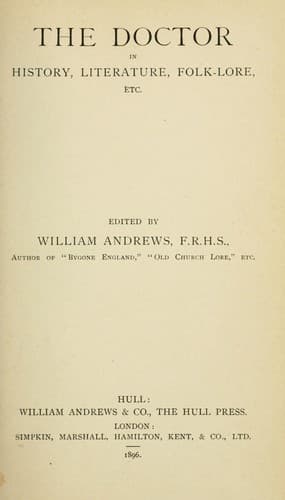
The Doctor in History, Literature, Folk-Lore, Etc.
History
The Doctor in History, Literature, Folk-Lore, Etc.
Literature and medicine; Physicians; Physicians in literature
A curious anecdote is related of Lord Chief Justice Holt. When a young
man, he, with companions who were law students like himself, ran up a
score at an inn, which they were not able to pay. Mr. Holt observed that
the landlord's daughter looked very ill, and, posing as a medical student,
asked what ailed her. He was informed she suffered from ague. Mr. Holt,
continuing to play the doctor, gathered sundry herbs, mixed them with
great ceremony, rolled them up in parchment, scrawled some characters on
the same, and to the great amusement of his companions, tied it round the
neck of the young woman, who straightway was cured of her ague. After the
cure, the pretending doctor offered to pay the bill, but the grateful
landlord and father would not consent, and allowed the party to leave the
house with hearts as light as their pockets.
Many years after, when on the Bench, a woman was brought before him
accused of witchcraft. She denied the charge, but said she had a wonderful
ball, which never failed to cure the ague. The charm was handed to the
judge, who recognised it as the very ball he had made for the young woman
at the inn, to help himself and his companions out of a difficult
position.[6]
In the west of England a live snail is sewn up in a bag and worn round the
neck as an antidote for ague; though others in the same district imprison
a spider in a box, and, as it pines away, so will the disease depart.
It is a common belief in the north of England that a person bitten by a
dog is liable to madness, if the dog which bit them goes mad. In order to
secure the bitten one from such a terrible fate, the owner of the dog is
often compelled to destroy it. Should he refuse to do so, the friends of
the injured party would probably poison it, The condition peculiar to the
morning following a night of debauchery, is said to need "a hair of the
dog that bit you," which doubtless refers to the means taken to prevent
ill effects following a dog bite. A wise saw from the Edda tells us that
"Dog's hair heals dog's bite." The following incident recorded in the
_Pall Mall Gazette_, Oct. 12th, 1866, shews most gross superstition in
this Victorian age. "At an inquest, held on the 5th of October, at
Bradfield, (Bucks.), on the body of a child of five years of age, which
had died of hydrophobia, evidence was given of a practice almost
incredible in civilised England. Sarah Mackness stated that at the request
of the mother of the deceased, she had fished out of the river the body of
the dog by which the child had been bitten, and had extracted its liver, a
slice of which she had frizzled before the fire, and had then given it to
the child to be eaten with some bread. The dog had been drowned nine days
before. The child ate the liver greedily, drank some tea afterwards, but
died, in spite of this strange specific."
Public-domain text, read in full here on John Shaqi.
Reviews
Reviews
No reviews yet
Be the first to share your thoughts on this work.
Elsewhere in the archive
Join the Discussion
Join the discussion
Sign in to leave a comment or review.
Sign InorCreate an account