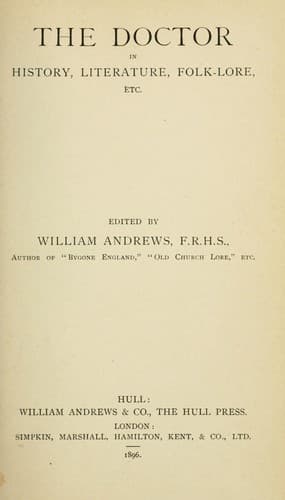
The Doctor in History, Literature, Folk-Lore, Etc.
History
The Doctor in History, Literature, Folk-Lore, Etc.
Literature and medicine; Physicians; Physicians in literature
Dr. Lettsom, a quaker in the time of George III., near the close of the
last century, had such an extensive practice that his receipts in some
years were as much as L12,000; and this although half his services were
entirely gratuitous, and rendered with unusual solicitude and care to
necessitous clergymen and literary men. Generosity was the ruling feature
of his life. On one occasion he attended an old American merchant whose
affairs had gone wrong, and who grieved over leaving the trees he had
planted. The kind hearted doctor purchased the place from the creditors,
and presented it to his patient for life.
Pope, a few days before his decease, bore the following cordial testimony
to the urbanity and courtesy of his medical friends:--"There is no end of
my kind treatment from the Faculty; they are in general the most amiable
companions, and the best friends, as well as the most learned men I know."
And Dryden, in the postscript to his translation of Virgil, speaks in the
same way of the profession. "That I have recovered," says he, "in some
measure the health which I had lost by too much application to this work,
is owing, next to God's mercy, to the skill and care of Dr. Guibbons and
Dr. Hobbs, the two ornaments of their profession, whom I can only pay by
this acknowledgment."
When Dr. Dimsdale, a Hertford physician and member of Parliament, went
over to Russia to inoculate the Empress Catherine and her son, in the year
1768, he received a fee of L12,000, a pension for life of L500 per annum,
and the rank of Baron of the Empire.
Dr. Henry Atkins was sent for to Scotland by James the Sixth to attend
Charles the First (then an infant), ill of a dangerous fever. The King
gave him a fee of L6000, with which he purchased the manor of Clapham.
Louis XIV. after undergoing an operation, gave his physician and his
surgeon 75,000 crowns each.
Dr. Glynn once attended the only son of a poor peasant woman, ministering
to his wants with port wine, bark, and delicacies. After the lad's
recovery, his mother waited on the doctor, bringing a large wicker basket
with an enormous magpie, which was her son's pet, as a fee to show their
gratitude.
A thousand pounds were ordered to be paid to Sir Edmund King for promptly
bleeding Charles the Second, but he never received this fee.
Dr. Mead, in the time of George the First, was generous to a degree, and
like many of his brethren, would not accept fees from curates, half-pay
officers, and men of letters. At home his fee was a guinea. When he
visited patients of means, in consultation or otherwise, he expected two
guineas or more. But to the apothecaries who waited on him at his coffee
houses of call he charged only half a guinea for prescriptions, written
without his having seen the patient. He had an income one year of L7,000,
and for several years received between L5,000 and L6,000, which,
considering the value of money at that time, is as much as that of any
living physician.
Public-domain text, read in full here on John Shaqi.
Reviews
Reviews
No reviews yet
Be the first to share your thoughts on this work.
Elsewhere in the archive
Join the Discussion
Join the discussion
Sign in to leave a comment or review.
Sign InorCreate an account