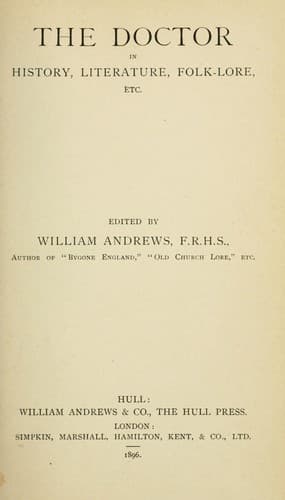
The Doctor in History, Literature, Folk-Lore, Etc.
History
The Doctor in History, Literature, Folk-Lore, Etc.
Literature and medicine; Physicians; Physicians in literature
The following story illustrates the too frequent weary waiting, when hope
makes the heart sick, and also shows on what curious casual incidents the
success of a career may sometimes turn. It has been told in different
ways, and attributed to different men, such as to Dr. Freind, and others;
but, quite possibly, the same or a similar incident may have repeatedly
occurred. I simply give it as it was narrated to me. A young doctor having
graduated with honours, took a house at a high rent in Harley Street,
London. The brass plate attracted no patients; months passed idly and
drearily, and the poor fellow took to drink. One night the door-bell
rang--a servant man, from a lady of title round the corner, begged him to
come at once, as his mistress was dangerously ill, lying on the floor; her
own doctor was out, and he was sent to fetch the first doctor he could
find. The young doctor regretfully thought what a fool he was, for here
was his chance, when he could not avail himself of it; but he would go,
and try hard to pull himself together.
When he reached the room, he had enough conscience or sense left to know
that he was not in a fit state to prescribe, and exclaiming, "Drunk, by
George!" took his hat and bolted from the house. Next morning he received
a scented note from the lady, entreating him not to expose her, inviting
him to call, and offering to introduce him professionally to her circle!
Before the season was ended, his practice was yielding him at the rate of
some L1500 a year!
Curiously enough, it is recorded of a British doctor that he once actually
took a fee from a _dead_ patient. Entering the bedroom immediately after
death had taken place, he observed the right hand tightly clenched.
Opening the fingers, he found in them a guinea. "Ah, that was clearly for
me," said the doctor, putting the gold into his pocket.
It may be remembered here, that the Royal College of Physicians, London,
was founded by Thomas Linacre, physician to Henry VIII., in 1518; and that
the Royal College of Physicians of Edinburgh was incorporated by Charter
of Charles II., November 20th, 1681.
As to the fees paid to physicians, we find that Dr. Edward Browne, the son
of Sir Thomas Browne, who became a distinguished physician in London, in
his Journal, under the date of February 16th, 1664, records: "I went to
visit Mr. Edward Ward, an old man in a feaver, when Mrs. Anne Ward gave me
my first fee, 10 shillings."
Public-domain text, read in full here on John Shaqi.
Reviews
Reviews
No reviews yet
Be the first to share your thoughts on this work.
Elsewhere in the archive
Join the Discussion
Join the discussion
Sign in to leave a comment or review.
Sign InorCreate an account