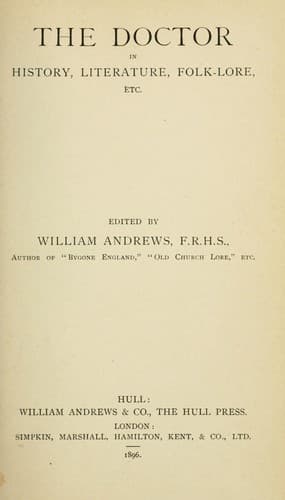
The Doctor in History, Literature, Folk-Lore, Etc.
History
The Doctor in History, Literature, Folk-Lore, Etc.
Literature and medicine; Physicians; Physicians in literature
ignored that certain successful writers once wrote "M.D." after their
names. Who cares that the author of that classic "Religio Medici" took his
degrees at Leyden and at Oxford, and dispensed medicine to the end of his
life? Who cares that the author of "The Borough," "Tales in Verse," and
"The Parish Register," was apprenticed to a surgeon? Who cares that the
writer of such dramas as "Virginius," "William Tell," and "The Hunchback,"
was trained for a physician? Who cares that the author of "Roderick
Random," "Peregrine Pickle," and "The Expedition of Humphrey Clinker" was
a surgeon's assistant and acted as surgeon's mate in the unfortunate
Carthagena expedition, before trying (unsuccessfully) to obtain a practice
in London? And, above all, who cares that the author of "The Deserted
Village" and "The Vicar of Wakefield" studied physic in Edinburgh and on
the Continent, and, as Boswell was informed, "was enabled to pursue his
travels on foot, partly by demanding at Universities to enter the lists as
a disputant, by which, according to the custom of many of them, he was
entitled to the premium of a crown, when luckily for him his challenge was
not accepted?" Such are a few of the examples which immediately occur to
the mind when the whole subject is contemplated.
It would be impossible in the compass of a short article to deal
systematically and comprehensively with doctors who became authors, or to
make out a complete list of their names with an account of the works which
entitled them to the designation. Any facts now adduced must be considered
arbitrary and capricious, so far as the choice of them is concerned; and
sequence is so little attempted that the reader will pardon, I trust, a
possible leap from Galen to Goldsmith, from Sir Thomas Browne to Tobias
Smollett, and from Sir John Blackmore to Conan Doyle. I put aside those
members of the profession who have simply written on professional
subjects. Their name is legion, but in the great majority of cases such
work as this would not strictly justify their inclusion among the
literati. And, on the other hand, we cannot find a place in the category
for such men as Goethe or Sainte-Beuve, for though both studied
medicine, it seems to have been purely with a view to the extension of
their knowledge and not with any more practical or material object.
Sainte-Beuve, it is true, for a short time in his youth entertained some
thought of adopting the profession; but Goethe only dipped into the
subject with the same spirit that he dipped into experimental chemistry
and astrology.
Public-domain text, read in full here on John Shaqi.
Reviews
Reviews
No reviews yet
Be the first to share your thoughts on this work.
Join the Discussion
Join the discussion
Sign in to leave a comment or review.
Sign InorCreate an account