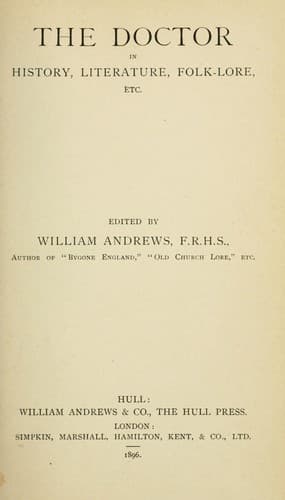
The Doctor in History, Literature, Folk-Lore, Etc.
History
The Doctor in History, Literature, Folk-Lore, Etc.
Literature and medicine; Physicians; Physicians in literature
The contrast between the graphic power displayed by Dickens in his
delineation of the characters of Bob Sawyer and Ben Allen, and the
indistinctiveness, as to profession, of his presentments of Allan
Woodcourt and Dr. Jeddler, may help us to understand the causes which
render his doctors so much less effective than his lawyers. The legal
profession presents more variety than the medical, and comes before us
more prominently in conjunction with incidents of a striking character, as
may be seen every day in the newspaper records of the courts of law and of
police. The physician and the surgeon stand as much apart, in these
respects, from the busy barrister or solicitor as the clergy do. Dickens
has not given us a clerical portrait, and probably for a similar reason.
Mrs. Oliphant, on the other hand, excels in her delineations of every
grade of the Anglican hierarchy; but her genius as a writer of fiction
runs in a groove essentially different from that of Dickens.
Famous Literary Doctors.
BY CUMING WALTERS.
Medical men have not so commonly made literature an extra pursuit, or
adopted it as a serious calling, as have the members of the other liberal
professions. It is quite expected that a clergyman should write poems,
philosophical essays, and perhaps even a novel with a purpose; and it is
usual to recruit the ranks of critics extensively from the law, and to
trust to briefless barristers for a continuous supply of romances. No
detail is more frequently discovered in the biographies of eminent authors
than that they were called to the Bar, and either never practised or
forsook practising in order to engage in literary labours. Indeed, it
might almost seem that failure in law was the most important step towards
success in authorship. No such rule applies, however, to medical men, and
no such comment would be justified in their case. Not only do we find the
writing of books--otherwise than text-books and technical
treatises--rarer with them, but it curiously happens that in most
instances it has been the successful practitioner, not the man walking the
hospitals or waiting for calls, who has turned author. And we shall find
that these medico-literati (if I may coin the phrase) have often been
among the most hard-working in their profession, and the wonder is that
they were able to enter upon a second pursuit and to follow it with so
much zeal. For, in most of the examples I shall advance, literature was
more than a pastime with these men who indulged in it. It was chosen by
some for its lucrativeness, and by the majority for its capacity to
enhance their reputation or to bring them enduring fame. This much may be
safely said, that the names of many excellent doctors would have faded
from public remembrance ere this, and would have passed away with the
generation to which they belonged, had not literature given them lasting
luminance. In not a few instances the fact is already forgotten or wholly
Public-domain text, read in full here on John Shaqi.
Reviews
Reviews
No reviews yet
Be the first to share your thoughts on this work.
Join the Discussion
Join the discussion
Sign in to leave a comment or review.
Sign InorCreate an account