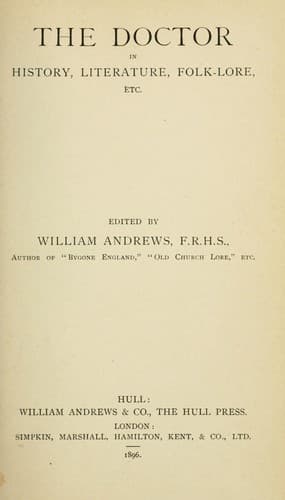
The Doctor in History, Literature, Folk-Lore, Etc. — John Shaqi
The Doctor in History, Literature, Folk-Lore, Etc.
History
The Doctor in History, Literature, Folk-Lore, Etc.
Literature and medicine; Physicians; Physicians in literature
Let us, then, refer to a few types certain of instant recognition. The
most notable of modern instances is Dr. Oliver Wendell Holmes, a
specialist in his profession, a hard-working physician, and the author of
valuable treatises on medical art, who nevertheless occupied the position
of being among the four chief poets whom America has produced, and one of
the most versatile of the litterateurs of the century. He went to the
Paris Medical Schools shortly after he had graduated at Harvard; he
practised as a physician at Boston; and for nearly forty years he was
Professor of Physiology. Yet he had time to write the most delightful and
original of philosophical essays, to publish novels of which at least
one--"Elsie Venner: A Romance of Destiny"--will rank as a classic; to
deliver orations and after-dinner speeches in sparkling verse, and to
write exquisite poems in rich and felicitous language on a wonderful
variety of themes, the complete collection of which makes a very
substantial volume. In all his work Dr. Holmes showed himself to be the
profound student of nature and of humanity with many varying interests;
yet we can often trace the hand of the physician in the work of the
essayist and poet. His novels were special studies which only the ardent
physiologist and metaphysician would have cared to discuss, or, at all
events, would have discussed so well. Both "Elsie Venner" and "The
Guardian Angel" deal with the occult problems of heredity, and those
problems are treated with the power of the specialist in certain branches
of science. Still more strongly is the character of the medical man
displayed in a number of the poems, some by reason of their subject, and
some by the figures and imagery they contain. The well-known "Stethoscope
Song" will immediately suggest itself in illustration. But, for purposes
of quotation, I prefer a less popular poem of rare beauty, which more
strikingly manifests the writer's power of transmuting the hard dry facts
of science into light and gleaming poetry. I refer to what he called at
first "The Anatomist's Hymn," but afterwards "The Living Temple." It is
one of the interpolated poems in the "Autocrat" series of papers, and to
my thinking invests the human body and its physical functions with
unimagined charms.
Take, for instance, this poetic exposition of our respiration, the
scientific correctness and exactness of which need no explanation to
readers of this volume:--
"The smooth, soft air with pulse-like waves
Flows murmuring through its hidden caves,
Whose streams of brightening purple rush
Fired with a new and livelier blush,
While all their burden of decay
The ebbing current steals away,
And red with Nature's flame they start
From the warm fountains of the heart.
Public-domain text, read in full here on John Shaqi.
Reviews
Reviews
No reviews yet
Be the first to share your thoughts on this work.
Join the Discussion
Join the discussion
Sign in to leave a comment or review.
Sign InorCreate an account