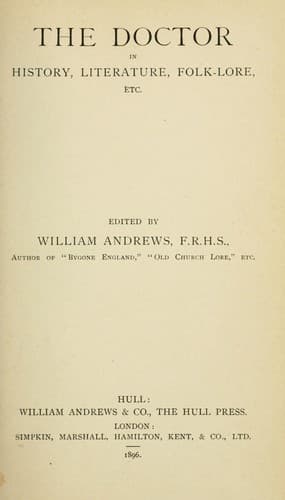
The Doctor in History, Literature, Folk-Lore, Etc.
History
The Doctor in History, Literature, Folk-Lore, Etc.
Literature and medicine; Physicians; Physicians in literature
No rest that throbbing slave may ask,
For ever quivering o'er his task,
While far and wide a crimson jet
Leaps forth to fill the woven net
Which in unnumbered crossing tides
The flood of burning life divides,
Then kindling each decaying part
Creeps back to find the throbbing heart.
But warmed with that unchanging flame
Behold the outward moving frame,
Its living marbles jointed strong
With glistening band and silvery thong,
And linked to reason's guiding reins
By myriad rings in trembling chains,
Each graven with the threaded zone
Which claims it as the master's own."
There is an almost irresistible temptation to linger over Dr. Oliver
Wendell Holmes' books, so intensely interesting is his personality and so
fascinating is his work. But several other eminent poets of the
profession demand attention. To Crabbe's connection with surgery I have
already incidentally referred, and inasmuch as he early abandoned the
calling for the ministry, little need be said except that his youthful
experience may have aided him in writing a scathing denunciation of the
Quack, who believed wholly in the potence of "oxymel of squills," and of
the Parish Doctor, who "first insults the victim whom he kills." The poet
was a severe castigator, and was never less forbearing with the lash than
when these impostors of his day were under his hand for flagellation. In
Mark Akenside we come to a better specimen of the class which we are
considering. At the age of twenty he went to Leyden, and three years later
became, (as Dr. Johnson writes) "a doctor of physick, having, according to
the custom of the Dutch Universities, published a thesis." In the same
year he published "The Pleasures of the Imagination," his greatest work.
This was followed by a collection of odes, but he still sought a
livelihood as a physician. Little success attended him, however, and Dr.
Johnson records that Akenside was known as a poet better than as a doctor,
and would have been reduced to great exigencies but for the generosity of
an ardent friend. "Thus supported, he gradually advanced in medical
reputation, but never attained any great extent of practice, or eminence
of popularity. A physician in a great city," his biographer continues
musingly, "seems to be the mere play-thing of Fortune; his degree of
reputation is, for the most part, totally casual; they that employ him,
know not his excellence; they that reject him, know not his deficiency."
Yet it was otherwise with Sir Samuel Garth, doctor and poet, of whom
Johnson himself records that "by his conversation and accomplishments he
obtained a very extensive practice." His principal poem was "The
Dispensary," relating to a controversy of the time between the College of
Physicians, who desired to give gratuitous advice to the poor, and the
Apothecaries, who wished to keep up the high price of medicine. Garth was
Public-domain text, read in full here on John Shaqi.
Reviews
Reviews
No reviews yet
Be the first to share your thoughts on this work.
Join the Discussion
Join the discussion
Sign in to leave a comment or review.
Sign InorCreate an account