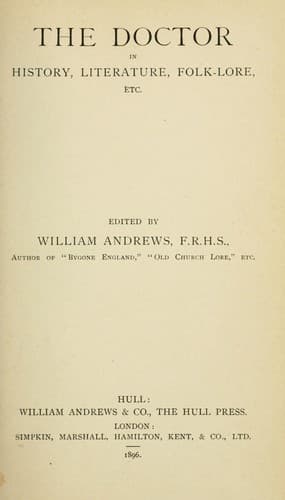
The Doctor in History, Literature, Folk-Lore, Etc.
History
The Doctor in History, Literature, Folk-Lore, Etc.
Literature and medicine; Physicians; Physicians in literature
twelve books--"A History of the Conspiracy against King William," and a
host of others which his perverted reason or fantastic fancy suggested.
Never, perhaps, was known such a voluminous author, or one so erratic in
his system. What with his long heroic poems, his treatises on smallpox and
other diseases, his theological controversies, his "Advices" to painters,
poets, and weavers, and his prose contributions to periodical
publications, "England's Arch-Poet" (as Swift described him) could never
have idled away an hour. Of all that he wrote, a few passages from his
"Arthur" and "Creation" are alone remembered, and but for Johnson's
good-natured attempt to save him from oblivion, his name would only have
lived in the satires of his remorseless critics. One saying of Blackmore's
only is worth noting here. He had laid himself open to the imputation of
despising learning, and Dr. Johnson himself thought him a shallow ill-read
man. But Blackmore said:--"I only undervalued false or superficial
learning, that signifies nothing for the service of mankind; as to physic
I expressly affirmed that learning must be joined with native genius to
make a physician of the first rank; but if those talents are separated, I
asserted, and do still insist, that a man of native sagacity and diligence
will prove a more able and useful practiser than a heavy notional scholar
encumbered with a heap of confused ideas."
One or two other doctors who in their time enjoyed a reputation as
writers, but whose fame was transient, or, at least, is insecure, call for
very brief notice before we pass on to a few of greater importance. Sir
John Hill, M.D., an eighteenth century physician, was a fairly extensive
litterateur, and in addition to producing treatises on botany, medicine,
natural history, and philosophy, wrote half a dozen novels, and several
dramas. His _chef d'oeuvre_ was "The Vegetable System," a work of such
magnitude that it ran to twenty-six volumes, a copy of which was presented
to the King of Sweden, and procured for the author the distinction of
being included in the Order of the Polar Star. Dr. William Fullarton
Cumming, a son of Burns' "Bonnie Leslie," was compelled to travel in mild
climates for his health, and as a result wrote "The Notes of a Wanderer,"
a work abounding in poetic descriptions of the charming scenery of the
East. He tells us that the real pleasure of travelling is not to boast of
how many lions one may have slain in a single day, but to saunter about
without an object, to inhale the moral atmosphere of places visited, to
enter bazaars, not to buy, but to catch the hundred peculiarities of a new
people, to stray hither and thither watching the work and the recreations
of other races. John Chalmers, M.D. (not to be confused with the great
divine, Dr. Thomas Chalmers), also deserves to be noted as a very graceful
writer of romantic stories; and Sir Henry Thompson, under the name of "Pen
Public-domain text, read in full here on John Shaqi.
Reviews
Reviews
No reviews yet
Be the first to share your thoughts on this work.
Join the Discussion
Join the discussion
Sign in to leave a comment or review.
Sign InorCreate an account