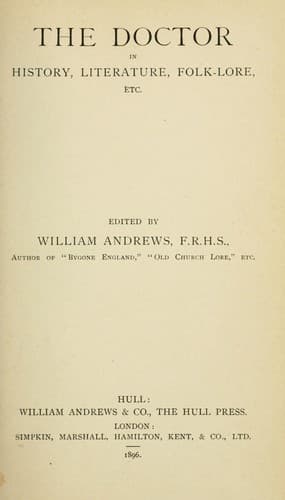
The Doctor in History, Literature, Folk-Lore, Etc.
History
The Doctor in History, Literature, Folk-Lore, Etc.
Literature and medicine; Physicians; Physicians in literature
Oliver," produced some years ago a strange little volume which enjoyed a
season's success--"Charley Kingston's Aunt."
That most diffident and most delightful of authors, Dr. John Brown, who
gave us the memorable "Rab and his Friends," was in practice at Edinburgh.
As long as lovers of the animal creation are to be found, the story of Rab
and of Marjorie will be read; and these sketches of brutes whom he almost
humanised will probably outlive the genial doctor's more ambitious "Horae
Subsecivae" and "John Leech and other Papers." Of a very different nature
was the author of "Ten Thousand a Year," Dr. Samuel Warren, physician,
lawyer, politician, novelist, and office-seeker. Tittlebat Titmouse is not
much studied now, for the type is out-of-date, and the society of which
the novel treats, the abuses prevalent, the general corruption which
prevailed in public life, were exposures intended for a past generation.
Yet there are passages in the work which should save it from absolute
neglect, and it has for over half a century kept its author's name alive.
This is more than his "Passages from the Diary of a late Physician" could
have done, or those dozen other works with the bare titles of which the
present reading public is scarcely acquainted. John Abercrombie, the chief
consulting physician in Scotland during the last century, sought and
achieved literary fame with two volumes on "The Intellectual Powers," and
"The Moral Feelings." They enjoyed a popularity scarcely commensurate with
their actual merits.
David Macbeth Moir, who faithfully performed the arduous duties of a
medical practitioner in Edinburgh, and whose life was almost wholly
devoted to the service of his fellows, was the famous "Delta" of
_Blackwood's Magazine_. His poems, some four hundred of which he
contributed to "Maga." alone, are out of fashion now, though their
delightful vein of reflectiveness and their charm of expression should
preserve them from absolute neglect. The heavy labours of his profession
did not seem to check his literary productiveness. His poems fill two
large volumes; his prose works are by no means meagre or unimportant, and
his "Sketches of the Poetical Literature of the past Half-century," is a
standard work on the poetry of his period. Medical treatises, too, came
from his pen; and his "Life of Mansie Wauch, Tailor," is one of the most
agreeable of genuine Scotch sketches. His biographer correctly summed up
the merits of the worthy doctor as a literary worker in the words "Good
sound sense, a simple healthy feeling, excited and exalted though these
may be, never fail him. He draws from nature, and from himself direct."
Quiet humour and simple pathos, a love of humanity, deep reverential
feeling, and originality of thought--all these are found in "Delta's"
writings, and serve, with his own admirable nature, to keep his memory
green.
Public-domain text, read in full here on John Shaqi.
Reviews
Reviews
No reviews yet
Be the first to share your thoughts on this work.
Join the Discussion
Join the discussion
Sign in to leave a comment or review.
Sign InorCreate an account