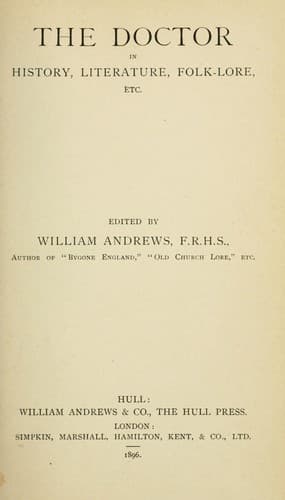
The Doctor in History, Literature, Folk-Lore, Etc.
History
The Doctor in History, Literature, Folk-Lore, Etc.
Literature and medicine; Physicians; Physicians in literature
medical man who has taken to literature, but the excuse of his early
training, combined with this curious result of it manifested in his
writing, proves irresistible.
Not to stray, however, but to get our feet once more upon solid ground, we
may refer to a classic example, with which this article, had it been aught
else but discursive, should have begun. Galen, the Greek physician, must
be counted among the first and most famous of his class who have written
literary works. He was so voluminous a writer on philosophical subjects
that scores of books on logic and ethics have been fathered upon him
without much question arising as to the unlikelihood of his being the
author of so many. As it is he is credited with eighty-three treatises,
the genuineness of which is not disputed; there are nineteen suspected to
bear his name unjustly, forty-five are proved to be spurious, and then
there remain a further fifteen fragments and fifteen commentaries on
Hippocrates, which may be accepted as his in part or whole. He made
himself master of the medical, physiological, and scientific knowledge of
his time. He was born in 130 A.D., and died in 201, and left a record of
that period. In addition to preparing this massive work, he seems to have
found time to devote himself to various branches of philosophy with such
success that later writers were well pleased to trade with the talisman of
his name. Were it worth while to go back to antiquity, and to the history
of foreign nations for further examples of physicians whose writings were
not confined to expositions of the medical system, Averrhoes, most famous
of Arabian philosophers, and physician to the calif, a master of the
twelfth century, would occupy a prominent position. But it is more to our
purpose to draw attention to the remarkable career, and one that deserves
to be held in remembrance, of Arthur Johnston, physician to King Charles
the First. In the same year that he graduated at the university of Padua
(1610) he was "laureated poet at Paris, and that most deservedly," as Sir
Thomas Urquhart recorded. He was then only three-and-twenty years of age,
and the prospect of many years being before him, he indulged in extensive
travel, and visited in turn most of the principal foreign seats of
learning. His journeying over, he settled in France and became equally
well known as a physician and as a writer of excellent Latin verse. A
courteous act, characteristic of the time, secured him the favour and
patronage of the English royal family, for in 1645 he published an elegy
on James I., and followed this up by dedicating a Latin rendering of the
Song of Solomon to King Charles. Other specimens of his rare culture and
his poetical powers were forthcoming, and he achieved a European
reputation. His Latin translation of the Psalms is held to be unexcelled
by any other, unless it be Buchanan's, and the fact that his translation
is still in use sufficiently attests its excellence and value. He died
Public-domain text, read in full here on John Shaqi.
Reviews
Reviews
No reviews yet
Be the first to share your thoughts on this work.
Elsewhere in the archive
Join the Discussion
Join the discussion
Sign in to leave a comment or review.
Sign InorCreate an account