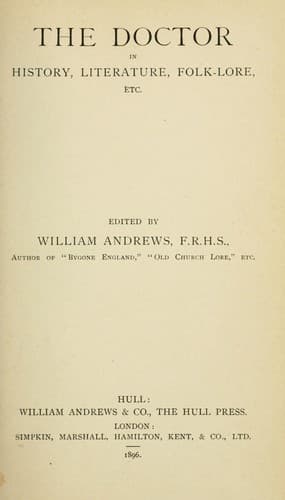
The Doctor in History, Literature, Folk-Lore, Etc.
History
The Doctor in History, Literature, Folk-Lore, Etc.
Literature and medicine; Physicians; Physicians in literature
suddenly in 1641, while on a visit to Oxford, and in the centuries which
have succeeded he has not been displaced in the front rank of refined and
deeply versed Latin scholars and poets.
It would be a matter of considerable difficulty to make a complete list of
literary doctors, but enough has perhaps been written to show that they
are no small band so far as numbers go, and that their influence in the
world of books has been very considerable and distinguished. We owe to
them many great works of enduring repute, of value to the student, of
perpetual entertainment to the general reader. When, too, we consider the
willingness and the zeal with which the writing members of the medical
profession have imparted their knowledge, we are led to believe that they
accepted as their motto the noble utterance of Sir Thomas Browne, the
chief of literary doctors:--"To be reserved and caitiff in goodness is the
sordidest piece of covetousness, and more contemptible than pecuniary
Avarice. To this (as calling myself a Scholar) I am obliged by the duty of
my condition: I make not therefore my head a grave, but a treasure of
knowledge; I intend no Monopoly, but a community, in learning; I study
not for my own sake only, but for theirs that study not for themselves. I
envy no man that knows more than myself, but pity them that know less. I
instruct no man as an exercise of my knowledge, or with an intent rather
to nourish and keep it alive in mine own head than beget and propagate it
in his; and in the midst of all my endeavours there is but one thought
that dejects me, that my acquired parts must perish with myself, nor can
be Legacied among my honoured Friends."
The "Doctor" in time of Pestilence.
BY WILLIAM E. A. AXON, F.R.S.L.
"I do not feel in me those sordid and unchristian desires of my
profession; I do not secretly implore and wish for Plagues, rejoice at
Famines, revolve Ephemerides and Almanacks in expectation of malignant
Aspects, fatal Conjunctions, and Eclipses."--SIR THOMAS BROWNE'S
"Religio Medici," pt. ii., sec. ix.
Of the great epidemics which have from time to time devastated Europe,
Great Britain has had its full share. Between 664 and 1665 there were many
visitations, resulting in heavy mortality, to which the general name of
plague or pestilence has been given, although they were not always
identical in form. Often the dread sisters Famine and Pestilence went hand
in hand in the domains of merrie England in the good old times.
Public-domain text, read in full here on John Shaqi.
Reviews
Reviews
No reviews yet
Be the first to share your thoughts on this work.
Elsewhere in the archive
Join the Discussion
Join the discussion
Sign in to leave a comment or review.
Sign InorCreate an account