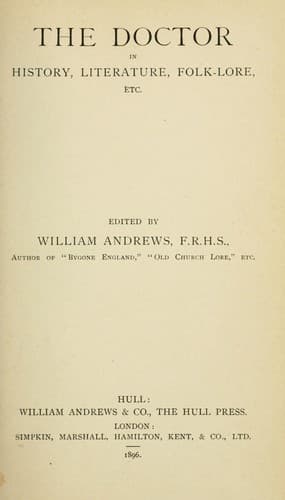
The Doctor in History, Literature, Folk-Lore, Etc.
History
The Doctor in History, Literature, Folk-Lore, Etc.
Literature and medicine; Physicians; Physicians in literature
a due sense of Hodges' services by a stipend and the position of physician
to the city. His "Loimologia" is an important contribution to the
literature of epidemics.
Hodges, who had thus been a witness of the Carnival of Death in the
metropolis of England, may well have pondered on the words of one of his
illustrious contemporaries, Sir Thomas Browne, who says:--"I have not
those strait ligaments, or narrow obligations to the world as to dote on
life, or be convulst and tremble at the name of Death. Not that I am
insensible of the dread and horrour thereof; or by raking into the bowels
of the deceased, continual sight of anatomies, skeletons, or cadaverous
reliques, like vespilloes or grave makers, I am become stupid, or have
forgot the apprehension of mortality: but that, marshalling all the
horrors and contemplating the extremities thereof, I find not anything
therein able to daunt the courage of a man, much less a well resolved
Christian.... For a Pagan there may be some motive to be in love with
life; but for a Christian to be amazed at Death, I see not how he can
escape this dilemma, that he is too sensible of this life, or hopeless of
the life to come."
Mountebanks and Medicine.
BY THOMAS FROST.
Mountebanks--a name derived from the Italian words _monta in banco_,
mounting a bench--were, in company with their attendant zanies, or "Merry
Andrews," a popular class of public entertainers down to the earlier years
of the present century. Their chief object, however, was not to provide a
free entertainment, but to dispose of their nostrums to the crowds which
the entertainment brought together. Andrew Borde, a medical practitioner
at Winchester, who obtained a more than local reputation, enjoying the
distinction of being one of the physicians of Henry VIII., is said to have
been the original "Merry Andrew." The story of his life is full of
interest, and furnishes some curious information concerning the manners of
his age and his class. Mr. George Roberts, who supplied Lord Macaulay with
much material for his "History of England," relates that Borde was a man
of great learning, and had travelled on the continent. He made many
astronomical calculations, which may not unfairly be supposed to have
been for the purposes of astrology. He was a celibitarian and an ascetic,
drinking water three times a week, wearing a hair-shirt next his skin, and
keeping the sheet intended for his burial at the foot of his bed. As a
mountebank, he frequented fairs, markets, and other places of public
resort, and addressed those assembled in recommendation of his medicines.
He was a fluent speaker, and the witticisms with which he interspersed his
lectures never failed to attract, obtaining for him the name of "Merry
Andrew."
Public-domain text, read in full here on John Shaqi.
Reviews
Reviews
No reviews yet
Be the first to share your thoughts on this work.
Elsewhere in the archive
Join the Discussion
Join the discussion
Sign in to leave a comment or review.
Sign InorCreate an account