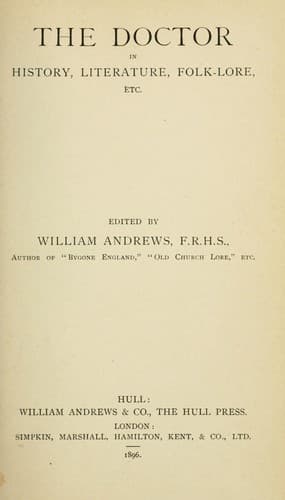
The Doctor in History, Literature, Folk-Lore, Etc.
History
The Doctor in History, Literature, Folk-Lore, Etc.
Literature and medicine; Physicians; Physicians in literature
The mountebanking quack flourished in great state in the first half of the
last century. "A Tour through England," published in 1723, gives the
following account of one whom the author saw at Winchester:--"As I was
sitting at the George Inn, I saw a coach with six bay horses, a calash and
four, a chaise and four, enter the inn, in a yellow livery, turned up with
red; four gentlemen on horseback, in blue, trimmed with silver: and as
yellow is the colour given by the dukes in England, I went out to see what
duke it was; but there was no coronet on the coach, only a plain
coat-of-arms on each, with this motto: ARGENTO LABORAT FABER. Upon
enquiry, I found this great equipage belonged to a mountebank, and that
his name being Smith, the motto was a pun upon his name. The footmen in
yellow were his tumblers and trumpeters, and those in blue his
merry-andrew, his apothecary, and his spokesman. He was dressed in black
velvet, and had in his coach a woman that danced on the ropes. He cures
all diseases, and sells his packets for sixpence a-piece. He erected
stages in all the market towns twenty miles round; and it is a prodigy how
so wise a people as the English are gulled by such pickpockets. But his
amusements on the stage are worth the sixpence, without the pills. In the
morning he is dressed up in a fine brocade night-gown, for his chamber
practice, when he gives advice, and gets large fees."
A passage in a letter written by the second Lord Lyttelton, about the year
1774, shows that this style of travelling was then still kept up by
mountebanks. He says:--"As a family party of us were crossing the road on
the side of Hagley Park, a chaise passed along, followed by a couple of
attendants with French horns. Who can that be, said my father? Some
itinerant mountebank, replied I, if one may judge from his musical
followers. I really spoke with all the indifference of an innocent mind:
nor did it occur to me that the Right Reverend Father in God, my uncle,
had sometimes been pleased to travel with servants similarly accoutred."
Nearly twenty years later, the famous quack, Katerfelto, travelled through
Durham in a carriage, with a pair of horses, and attended by two negro
servants in green liveries, with red collars. In the towns he visited
these men were sent round to announce his lectures on electricity and the
microscope, blowing trumpets, and distributing hand-bills.
Public-domain text, read in full here on John Shaqi.
Reviews
Reviews
No reviews yet
Be the first to share your thoughts on this work.
Elsewhere in the archive
Join the Discussion
Join the discussion
Sign in to leave a comment or review.
Sign InorCreate an account