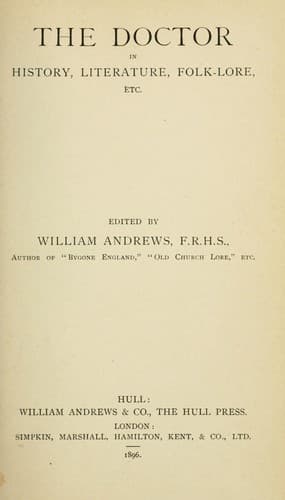
The Doctor in History, Literature, Folk-Lore, Etc.
History
The Doctor in History, Literature, Folk-Lore, Etc.
Literature and medicine; Physicians; Physicians in literature
How recollections will crowd upon the mind when a train of thought is set
in motion by the association of ideas! When, many years ago, I visited Dr.
Kahn's anatomical museum, then located in Tichborne Street, I there saw a
human skeleton which was affirmed by the lecturer, Dr. Sexton, to be that
of John Bishop, who was hanged in 1831, for the murder of an Italian boy
named Carlo Ferrari, at a house in Nova Scotia Gardens, one of the slums
then existing in the north-eastern quarter of London. Though nearly forty
years had elapsed since the commission of the crime, and I was only ten
years of age when I heard the horrible story which the sight of that
ghastly relic of mortality recalled to my mind, all the incidents
connected with it immediately passed before my mental vision like a
hideous phantasmagoria. The vividness with which they came back to me may
be accounted for by the deep impression which they made upon my mind at
the time of their occurrence. Those whose memories will carry them back
sixty years will readily understand this.
At the time when the public mind was harrowed by the narration in the
newspapers of the horrible circumstances connected with the murder, and
for some time previously, a fearful excitement had been created in all
parts of the country by stories of murders committed and graves robbed of
their ghastly tenants for the purpose of supplying with "subjects" the
dissecting tables of the London and Edinburgh schools of anatomy. In the
latter city two miscreants named Burke and Hare had been convicted of
murder for this purpose, and one of them hanged for their crimes; but the
scare had not abated. Stories were told with appalling frequency of
corpses missing from lonely graveyards and of narrow escapes from murder
in little frequented places. Chloroform had not then been discovered, but
the Scotch professors of the art of murder had introduced the practice,
popularly named after one of them, of disabling their victims by means of
a pitch plaster suddenly clapped on the mouth. Every person who was
missing was thought to have been "burked," and the watching of graves to
prevent the removal of newly-buried corpses became an established
practice. As the dark nights of the late autumn came on, the fears of the
timid and nervous were doubled, and persons who lived in lonely places, or
in the ill-lighted parts of towns, became afraid to leave their houses
after nightfall. I remember hearing such fears expressed by several
persons at Croydon, with whom my parents were acquainted, and also of
neighbours combining to assist in watching the graves of deceased members
of each others' families.
Public-domain text, read in full here on John Shaqi.
Reviews
Reviews
No reviews yet
Be the first to share your thoughts on this work.
Elsewhere in the archive
Join the Discussion
Join the discussion
Sign in to leave a comment or review.
Sign InorCreate an account