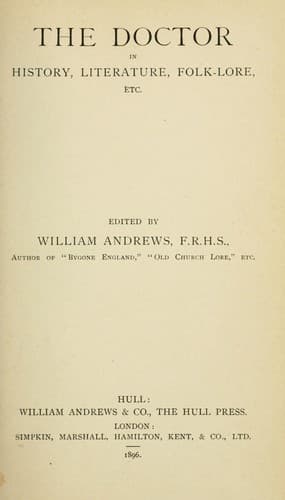
The Doctor in History, Literature, Folk-Lore, Etc.
History
The Doctor in History, Literature, Folk-Lore, Etc.
Literature and medicine; Physicians; Physicians in literature
Delightful old Fuller tells us "Necessary and ancient their Profession
ever since man's body was subject to enmity and casualty." There is no
doubt of the necessity and antiquity of the doctor's calling, but there
is, without doubt, no profession in which such great and beneficent
advance has been made in modern times as in the medical. The tortures
which our fathers endured under the old treatment are terrible to think
of. It was not enough that they were afflicted by disease; the pains which
they had to suffer from the supposed remedies far exceeded those which
nature imposed. Cupping, blistering, and especially bleeding, were the
common applications in nearly all complaints, the Bleeding was also used
as a preventive, which proverb truly tells us "is better than cure"; but
in this case the supposed disease could scarcely have been worse than the
supposed prevention. Five times in the year--"in September, before
Advent, before Lent, after Easter, and at Pentecost"--were the periods at
which men in health were accustomed to "breathe a vayne." Besides letting
of blood, the physician's cane and the surgeon's club were vigorously used
on the unfortunate sufferers. Mr. J. C. Jeaffreson, in his very
interesting "Book about Doctors," says, "For many centuries fustigation
was believed in as a sovereign remedy for bodily ailments as well as moral
failings, and a beating was prescribed for an ague as frequently as for
picking and stealing." So what with the lancet and the stick combined, our
fathers must indeed have shuddered at the approach of any of the "natural
shocks that flesh is heir to."
The medicines of those good old times were of a very strange and
objectionable kind. Some of the concoctions were composed of many
ingredients, and were formed of abominable, not to say disgusting,
materials. All nature was ransacked for out-of-the-way and horrible things
which could be used as drugs and nostrums for suffering and gullible
sufferers. In the reign of Charles II., Dr. Thomas Sherley "recommended a
clumsy and inordinate administration of violent drugs" for gout. "Calomel
he habitually administered in simple doses. Sugar of lead he mixed
largely in his conserves; pulverized human bones he was very fond of
prescribing; and the principal ingredient in his gout-powder was 'raspings
of a human skull unburied.' But his sweetest compound was his 'Balsam of
Bats,' strongly recommended as an unguent for hypochondriacal persons,
into which entered adders, bats, sucking-whelps, earth worms, hogs'
grease, the marrow of a stag, and the thigh-bone of an ox." A good idea of
the things sold to a confiding public as cures for its ills may be
gathered from two verses on Colonel Dalmahoy, a well-known--shall we say
quack--of the past:--
"Dalmahoy sold infusions and lotions,
Decoctions, and gargles, and pills,
Electuaries, powders, and potions,
Spermaciti, salts, scammony, squills.
Public-domain text, read in full here on John Shaqi.
Reviews
Reviews
No reviews yet
Be the first to share your thoughts on this work.
Elsewhere in the archive
Join the Discussion
Join the discussion
Sign in to leave a comment or review.
Sign InorCreate an account