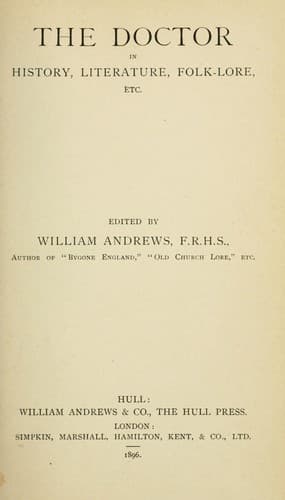
The Doctor in History, Literature, Folk-Lore, Etc.
History
The Doctor in History, Literature, Folk-Lore, Etc.
Literature and medicine; Physicians; Physicians in literature
The most innocent articles used in the old medicines were fruits, and
herbs, and vegetables. To some kinds special virtues are assigned, and Dr.
Bulleyn's "Book of Simples," is very pleasant reading. "Pears, apples,
peaches, quinces, cherries, grapes, raisins, prunes, raspberries, oranges,
medlons, raspberries and strawberries, spinage, ginger, and lettuces are
the good things thrown upon the board." We are told of a prune growing at
Norwich, and known as the "black freere's prune," that it is "very
delicious and pleasaunt, and no lesse profitable unto a hoate stomacke."
"The red warden is of greate virtue, conserved, roasted or baken to quench
choller." We are also informed that "Figges be good agaynst melancholy,
and the falling evil, to be eaten. Figges, nuts, and herb grase do make a
sufficient medicine against poison or the pestilence. Figges make a good
gargarism to cleanse the throates."
Some of the Doctor's prescriptions are very curious. He prescribes "a smal
young mouse rosted," for a child afflicted with a nervous ailment. Nor did
he disdain to use the snail in certain cases. He tells us that "Snayles
broken from the shelles and sodden in whyte wyne with oyle and sugar are
very holsome, because they be hoat and moist for the straightnes of the
lungs and cold cough. Snails stamped with camphery, and leven will draw
forth prycks in the flesh." Snail broth is not entirely unknown in some
country places, even at the present time. Bezoar stone and unicorn's horn
were also used in confections.
Cancer has always been, and unfortunately still is, a terrible and an
incurable disease, and has afforded a fine field for all kinds of nostrums
and specifics which were to produce a "safe and certain cure." One of
these, called a "precious water," was thus composed. "Take dove's foote, a
herb so named, Arkangell ivy with the berries, young red bryer toppes, and
leaves, whyte roses, theyre leaves and buds, red sage, celandyne and
woodbynde, of each lyke quantity, cut or chopped and put into pure cleane
whyte wyne, and clarified honey. Then breake into it alum glasse and put
in a little of the pouder of aloes hepatica. Destill these together softly
in a limbecke of glasse or pure tin; if not then in a limbecke wherein
aqua vitae is made. Keep this water close. It will not onely kyll the
canker (cancer), if it be duly washed therewyth; but also two droppes
dayly put into the eye wyll sharp the syght, and breake the pearle and
spottes, specially if it be dropped in wyth a little fenell water, and
close the eyes after."
Public-domain text, read in full here on John Shaqi.
Reviews
Reviews
No reviews yet
Be the first to share your thoughts on this work.
Elsewhere in the archive
Join the Discussion
Join the discussion
Sign in to leave a comment or review.
Sign InorCreate an account