It should be made by siding up outside the studding with cheap
lumber. On this is placed a layer of roofing paper and over it the
ordinary siding. The windows of a chicken-house should furnish
sufficient light that the hens may find grain in the litter on
cloudy days. Too much glass in a poultry house makes the house cold
at night, and it is a needless expenditure.
The subject of roofing farm buildings may be summarized in this
advice: Use patent roofing if you know of a variety that will last;
if not, use shingles. Shingle roofs require a steeper pitch than do
roofs of prepared roofing. A shingle roof can be made much warmer by
using tightly laid sheathing covered with building-paper. Especial
care should be taken that the joints at the eaves of the house are
tightly fitted.
The object of ventilating a chicken-house is to supply a reasonable
amount of fresh air, and, equally important, to keep the house dry.
Ventilation should not be by cracks or open cupolas. Direct drafts
of air are injurious, and ventilation by such means is always the
greatest when the least needed.
Schemes of ventilation by a system of pipes are expensive and
unnecessary. The latest, best and cheapest plan for providing
ventilation is the curtain front house for the north, and the open
front house for the more southerly sections. The curtain front house
is giving way to the open front with a somewhat smaller opening in
sections, as far north as Connecticut.
Make all roosts on the same level. The ladder arrangement is a
nuisance and offers no advantage. Arrange the roosts so that they
may be readily removed for cleaning. Do not fill the chicken-house
full of roosts. Put in only enough to accommodate the hens, and let
these be on one side of the house. The floor under the roosts should
be separated from the feeding floor by a board set on edge.
For laying flocks the nests must be clean, secluded and plentiful.
Boxes under the roost-platform will answer, but a better plan is to
have the nest upon a shelf along a side wall so arranged as to allow
the hen to enter from the rear side. Nests should be constructed so
that all parts are accessible to a white-wash brush. The less
contrivances in a chicken-house, the better.
The farmer can get along very well without any chicken-yard at all.
It will, however, prove a very convenient arrangement if a small
yard is attached to the chicken-house. The house should be arranged
to open either into the yard or out into the range. This yard may be
used for fattening chickens or confining cockerels, or perhaps to
enclose the flock during the ripening of a favorite tomato or berry
crop.
THE END.
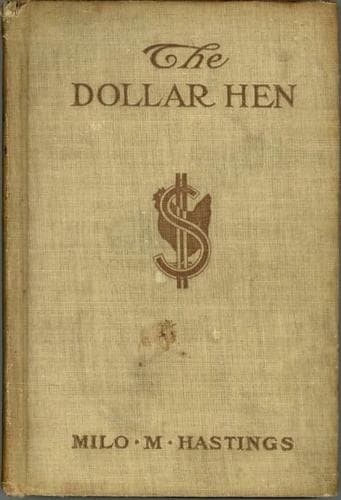
End of the Project Gutenberg EBook of The Dollar Hen, by Milo M. Hastings
Public-domain text, read in full here on John Shaqi.
Reviews
Reviews
No reviews yet
Be the first to share your thoughts on this work.
Elsewhere in the archive
Join the Discussion
Join the discussion
Sign in to leave a comment or review.
Sign InorCreate an account